Showing posts with label China. Show all posts

Thursday, 11 April 2024

"Trapped In The Flash" | The Red Strings

On a recent walk about at Washington Square Park, I chanced on performance art type of dance by two talented Chinese women; Jiening (Sophia) Zhu and Jiyun (Annora) Dong, both actors and artists from the NYU Tisch Drama's Experimental Theatre Wing.

Described as "a conversation with red strings, feminism, experimental theater and the body", these graceful and lithe dancers spent about 2 hours showcasing their forthcoming “Trapped in the Flash”, a one-hour off off broadway show that follows the lives of three Chinese American characters from varied historical periods – a photographer, an actress, and a railroad worker. The narrative unfolds through non-linear vignettes that span their experiences in America and their ties to China. 

At first glance, I thought the performance might've been similar to Shibari, the Japanese rope bondage (also known as "kinbaku"), which is a modern form of rope bondage originating in Japan. However, it has nothing to do with it.

The performance "....is about being trapped. It's about trying to escape. It's an exploration about power and space."

There's also "The Red Thread of Fate"; an East Asian belief originating from Chinese mythology. It is commonly thought of as an invisible red cord around the finger of those that are destined to meet one another in a certain situation as they are "their one true love".


Monday, 20 March 2023

AI-Generated | The Tea House & Street Series

Lin Dai. (1934-1964)

I chose to name this portrait as the screen goddess Lin Dai. Born in Guangxi, China in 1934, she became the foremost star of Mandarin films as she won the hearts of audiences with more than 40 films. She died by suicide in 1964. I used MidJourney V4 and refined it by using ON1 Photo Raw 2023. 

The prompts are as follows: 
[A young Chinese Opera woman wearing blue cheongsam, red lipstick, full body shot, a cup of tea, teahouse background, photography by Annie Leibovitz. -- no hands.]. 

The hands are still an issue with V4, so -aside from editing the image- I also had to improve/alter the hand that rests on the table. I left the other one untouched.

Zhou Xuan, Actress and Singer. (1920-1957)

Zhou Xuan was an iconic Chinese singer and film actress. By the 1940s, she had become one of China's Seven Great Singing Stars. She was the best known of the seven, nicknamed the "Golden Voice", and had a concurrent movie career until 1954. She recorded more than 200 songs and appeared in over 40 films in her career. I've added prompts to get a full body and a 1940 street in Shanghai.

I used MidJourney V4 and refined the image by using ON1 Photo Raw 2023. 

The prompts are:

[Young beauty attractive lady wearing cheongsam, style by film Rouge, full - body shot, walking on the street in 1940s Shanghai, style by Yasutomo Oka, 8k, HD, cinematography, photorealistic, epic composition Unreal Engine, Cinematic, Color Grading, landscape Photography, Ultra - Wide Angle,Depth of Field, etc. -- no hands]

Betty Loh Ti (Hsi Chung-i). Chinese Actress. (1937-1968)

Betty Loh Ti (July 24, 1937 – December 27, 1968), also known as Le Di or Loh Tih, was a Hong Kong actress originally from Shanghai. Known as the "Classic Beauty", she was one of the most celebrated actresses of Hong Kong cinema. She -as some of her contemporaries- died by suicide.

I used MidJourney V4 and refined the image by using ON1 Photo Raw 2023. 

The prompts (very basic) are:

[A young Chinese Opera woman wearing blue cheongsam, red lipstick, full body shot, a cup of tea, teahouse background, photography by Annie Leibovitz. no hands.]

Yoshiko Kawashima (1907-1948)

Yoshiko Kawashima (1907–1948) was a Qing dynasty princess who was raised in Japan, and who served as a spy for the Japanese Imperial Army during the Second Sino-Japanese War.

The prompts are:

[Young beautiful attractive Chinese Opera woman wearing pale blue long cheongsam, looking back at camera, style by film In The Mood For Love, full - body shot, walking in street in 1940s Shanghai, photography by Annie Leibovitz, dynamic composition, 8k, HD, cinematography, photorealistic, epic composition, etc. -- no hands]

Bak Yin, Queen of Cantonese Films. (1920-1987)

Bak Yin known as the "Queen of Cantonese films" was born in Guangzhou in 1920. She started her movie career in 1936. Before the Japanese occupation forced the industry to shut down in 1941, she had starred in over 30 films. After the end of the war in 1945, she became one of the few pre-War stars to reclaim "leading lady" status.

The prompts are:

[A young beautiful Chinese Opera woman wearing yellow cheongsam, red lipstick, full body shot, a cup of tea, teahouse background, photography by Annie Leibovitz. -- no hands]

Soong Ch'ing-ling (Madame Sun Yat-sen). 1893-1981

Soong Ch'ing-ling was the third wife of Sun Yat-sen (President of the Republic of China 1919-1925). She was a politician and following Sun Yat-sen's death, she strongly supported the Communist government, and was appointed by Mao Tse-tung to various important posts.  

The prompts are:

["Young beautiful attractive Chinese Opera woman wearing black long qipao, style by film In The Mood For Love, full - body shot, walking in street in 1940s Shanghai, photography by Annie Leibovitz, dynamic composition, 8k, HD, cinematography, photorealistic, epic composition Unreal Engine, Cinematic, Color Grading, landscape Photography, Ultra - Wide Angle, etc."]

Wednesday, 25 January 2023

Ming Dynasty Fashion | Chinese New Year


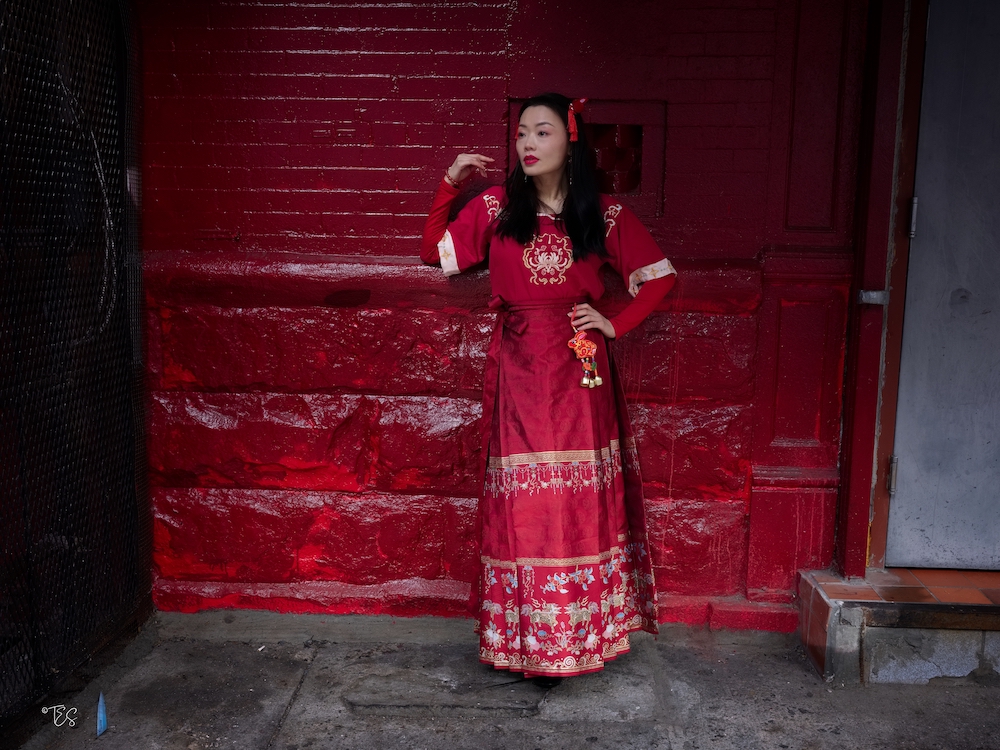
With the advent of the Chinese New Year (Year of The Rabbit), which is also commonly referred to as the Spring Festival, Lise Liu and I decided to hold a photo session in Manhattan's Chinatown featuring her in a red "horse-face" skirt and matching top. The skirt ("Ma Mian 马面) originated during the Song Dynasty (960-1279) and grew very popular during the Ming Dynasty (1368-1644) due to its functionality and aesthetic style.

In Chinese culture, the color red is believed to be a lucky color and a representation of fire. It's revered as the auspicious color that wards off evil to those who adorn it or have it. It's dominant in the New Years’ celebrations, and ushers in the new year with good luck and fortune.

The photo session took place in some streets of Manhattan's Chinatown....mostly on its "east" side to avoid the tourist spots. Having scouted the area, I was glad to have located a couple of spots with dark walls that would serve well as backdrops.

On a side note: red on a black (or dark) background is always eye-catching.


And for larger and better resolution photographs:


Ming Dynasty Fashion by Tewfic El-Sawy on on Exposure

Saturday, 28 May 2022

Bao Bleu

A just published article in the T Magazine of The New York Times caught my eye and while it's a sort of advertisement for an exquisitely elegant dim sum Chinese restaurant in Paris, the video -which I found on its website- reminded me of Wong Kar Wai's famous In The Mood For Love and my own The Wasted Years (which was photographed in a Chinese restaurant in NYC's West Village).

From the article: "...The bao and dim sum restaurant nods to traditional Chinese teahouses and incorporates bold materials and colors, particularly the blue and white of traditional porcelain. The ground floor features velvet banquettes and an oversize reproduction of a Ming painting offset by neon yellow trim, while the upper level has more of a boudoir feel. Armchairs and daybeds replace tables and chairs, and Maison Martin Morel floral wallpaper inspired by Wong Kar-wai’s film “In the Mood for Love” sets a romantic scene for throwing back char siu bao, Dongpo pork and ginger milk pudding.

In comparison, here's The Wasted Years:

Sunday, 4 October 2020

Sung Kwan Ma | Hanoi Portraits

Photo © Sung Kwan Ma | All Rights Reserved

It's always a genuine pleasure to view the work of a photographer who shares many of one's own aesthetic, as well as geographic affinities. Through a mutual Facebook contact, I discovered the lovely work of Sung Kwan Ma, a photographer born in Seoul and now based in New York City. He has a number of galleries on his website, that include work from various cities in India, China, Thailand, Cambodia, Sri Lanka, Myanmar and Viet Nam. His work includes portraits and street photography, as well as wedding photography...both in color and monochrome.

It's his Viet Nam photographs that I loved the most, especially those of his street portrait sessions of Thu Thuy, a Hanoi-based model. He has chosen to photograph her amongst the bustle of the old quarter in Hanoi, known as Pho Co; one of my favorite areas for street photography because of its ambiance and exotic back walls that are often inscribed with mobile telephone numbers as adverts...and where the beauty of the Vietnamese model in her traditional red and white ao dai is amply displayed.

Interestingly, he has also used the widescreen 16:9 aspect ratio in his framing for a selection of his portraiture work, such as in Shanghai and in NYC. He preceded me in that style, as I am preparing to do the same in a forthcoming project with Lise Liu (see my previous post).

As per his website, Sung's extensive spiritual journeys in India and humanitarian activities throughout Asia over the past two decades have been the soul and defining framework of his work. He specifically mentions his affinity to the various cultural diversities of India and the Indian people. His images seek to capture the emotional depth of traditional sentiments and the joys of festivity.

A photographer to follow.

Saturday, 19 September 2020

Looking For Mei Wu


As per my earlier blog post, I had arranged with Lise Liu to wear a qi pao/cheongsam to take on the role of an imaginary woman looking for traces of her long deceased grandmother in the narrow alleys of Chinatown at a time when the area was controlled by gangsters. The photo-film is titled "Looking For Mei Wu".

Readers can either view the photo film on Vimeo (above) or alternatively on YouTube.


Saturday, 11 July 2020

The Qi Pao, Pill Box Hats & Shanghai Fashion 1930s

Photo © Tewfic El-Sawy | All Rights Reserved
One of my photographic interests is visual stories "photo-films" (see an example The Girl of Nanjing) that endeavor to recreate Shanghai in the 1930s by using fashion elements popular during its heyday era. The most popular fashion statement of the time was the qi pao (aka the cheongsam in Cantonese) which evolved to its present form over the years of the Qing Dynasty (1644-1922).

During that dynastic period, women of Han descent wore two piece outfits while the Manchu women wore a long robe. With the advent of unity in China, women all over the country began to wear the qipaoEarly on in the 1900s, the qipao was loose-fitting, generally long-sleeved, and worn with unadorned, plain hairstyles. The modern version of the dress, now recognized as the ‘standard’ qipao, was developed in Shanghai in the 1920s, and became more form-fitting and with a high cut, and frequently worn with hairdos known as "finger waves".

Photo © Tewfic El-Sawy | All Rights Reserved
Evolving from its original appearance as a plain and sober Chinese robe to a more exciting style, the qi pao eschewed more traditional silks embellished with embroidery for cheaper contemporary textiles, with a greater variety of designs such as florals, dragons and geometrical patterns.

Society women in China knew that wearing their qi pao with its high collar, side slits and hour-glass body-conscious shape was being equated with an Eastern mystique. They added fur stole in winters, and pill box hats with veils to add more mystery to their appearance. The latter were invented by milliners and hat-makers in the 1930s, and were hugely popular for their simplicity and elegance. 

During the Chinese Cultural Revolution (1966–1976), the qi pao was seen as a feudal dress of the ancient times, and abandoned as daily clothing. However, in 1984, the qi pao/cheongsam was specified as the formal attire of female diplomatic agents by the People's Republic of China.

Uncredited Photo. Source Pinterest

Wednesday, 1 July 2020

My Work : Expecting Godot?

Photo © Tewfic El-Sawy | All Rights Reserved
My favorite neighborhood for street photography is -and has always been- Manhattan's Chinatown which, by now, I almost know like the back of my hand. Walking its streets transports me to Asia; to Hong Kong, to Shanghai or to Beijing. Although it's virtually impossible to photograph facial expressions due to the face coverings, there are some whose body language and/or dangling masks make for interesting images.

I noticed this man leaning against a half painted plywood board on Mott Street; pursed lips, hands in his pocket, and waiting for something or someone. I hadn't noticed that his belt was well used...possibly either not his or he had lost a lot of weight. 

What I did notice was the sun gleam reflected on the plywood board that looked like a dancer...it was as if the man was hypnotized by her movements.

For post-processing, I used the ON1 editing software and chose one of its new vintage wet-type presets, and added some contrast and saturation. 


Saturday, 30 May 2020


RESURRECTION by Tewfic El-Sawy on Exposure

The word translated as "resurrection" comes from the Greek a·naʹsta·sis, which means "raising up" or "standing up again". I've been walking the streets of Manhattan's Chinatown on a weekly basis to photograph its evolution to what some now call "the new normal". 

This week, I witnessed a tangible revival of its commercial activities...and noted with appreciation how the vast majority of its residents were adhering to the precautionary directives issued by the City and the State. I saw signs of optimism amongst the retailers, and a return of normalcy on its narrow sidewalks exemplified by the "nainais" with their wheeled shopping bags filled with fresh produce, shrugging off my theatrical whelps when these occasionally hit my shins.

I also saw many efforts by the Chinese community to help its most vulnerable; whether by distributing free meals at the Chinese Community Center or at Mott 41.

Unlike my previous monochromatic photo essays documenting Manhattan's Chinatown during Covid-19, this photo essay is in color...slightly unnatural in tone...as a way to convey that it's not totally back to its feet yet, but is getting there.

My previous photo essays:

Part I of Chinatown In The Time of COVID-19 I is here.

Part II of Chinatown In The Time of COVID-19 is here.

Part III of Chinatown In The Time of COVID-19 is here.


Tuesday, 12 May 2020

NYC's Chinatown During COVID-19


Manhattan's Chinatown is one of the oldest and largest concentrations of Chinese people outside of China. Still comprising more than 90,000 inhabitants as of today, its colorful banners and bustling street marketplaces were a persistent fixture of lower Manhattan. I use the past tense here because Chinatown (and there are many more in New York and elsewhere in the United States) has been hit hard by the lockdown orders imposed by New York State due to the outbreak of Covid-19.

Chinatown in lower Manhattan can trace its history to Guangzhou-born businessman Ah Ken; the first person to permanently settle on Mott Street where he opened a cigar shop on Park Row in 1858.

The decline of the mining business on the West Coast of the United States pushed the earliest Chinese immigrants to the East Coast, and Mott Street became the center of these immigrants willing to take low-paying jobs in cigar-rolling and textiles.

Having the good fortune of living not far from Chinatown, I often walked its busy, narrow streets from Chatham Square’s statue of Lin Zexu, a Qing dynasty official who led the fight against Britain’s illegal importation of opium; the odd pagoda-style roof and Buddhist temple; and the atmospheric Doyers Street, with its basement bars and a famous tea parlor...listened to the rather discordant singing in Columbus Park and even photographed a number of Cantonese operas at the Chinese Community Center for my Chinese Opera of the Diaspora photo book.

It's been over two months at least since restaurants in New York City closed because of the viral outbreak. Some believe that many of the businesses might not survive, and don't think Chinatown as we know it, will ever be the same again. As stay-at-home policies were gradually instituted, Chinatown — along with other high-traffic destination Manhattan neighborhoods like Midtown — further emptied, leaving haunted, vacant streets with a fraction of its businesses still operating. Whereas there had previously been almost 300 restaurants in Chinatown, almost all have closed except for a handful who survive by offering take-out and delivery. 

Over the past 4 weeks or so, I've witnessed a few strands of normalization in the neighborhood's activities. There were progressively more pedestrians and shoppers in some of the streets that have grocery stores and pharmacies. Social distancing was observed on the grocery lines; some of which snaked for half a block. Facial masks were seen in Chinatown early on in 2020. Mask wearing may be the reason for the low incidence of Covid-19 hospitalizations amongst Asians.

On May 7 I sensed a little " exhalation" after the long breath holding since mid-March, and even much earlier by this community. I witnessed an extraordinary long line waiting for tellers at a local bank...it snaked for a few blocks. Was it because Thursday is a traditional payday? Some of the small-time vegetable and fruit sellers were back, doing a brisk business in selling their fresh produce. There was also a long line for free food distributed by the Chinese Community Centre. 

Notwithstanding widespread closures, I felt a sense of hope, and of stoic resignation which I believe underscores the resilience of the people of Chinatowns everywhere.

Friday, 20 March 2020

Havana's Chinatown | Lok Pok-chi

Photo © Lok Pok-chi - All Rights Reserved
I make it a daily habit to read the South China Morning Post, and was very interested in an article that appeared on its pages a few days ago. It tells us the story of Lok Pok-chi, a photographer born in Hong Kong and based in Kansas, who accidentally met Caridad Amaran, a 90-year old talented singer of Chinese opera in Havana.

When they met, she scrubbing oil off a Chinese printing press with a kerosene-soaked toothbrush. Ms. Amaran has been performing since childhood, and is still an active singer. She is one of the subjects featured in photographer Lau Pok-chi’s latest solo exhibition, “Chinese Diaspora”. I couldn't find a link to it, but I did locate a short video featuring Lok Pok-chi and her, (starting at 07:35) amongst other images of Havana.


For more on Lok Pok-chi, here's a link to his website.

Saturday, 15 February 2020

Chunyun 春運 | The Largest Human Migration


"Chunyun", the world's largest annual human migration takes place every Chinese New Year. This cultural phenomenon consists of over three billion passenger-journeys, largely for the purpose of spending treasured time with family. It usually begins 15 days before Lunar New Year's Day and lasts for around 40 days.

Of the phenomenal 3 billion journeys, 2.43 billion trips will be made by automobile, 440 million by rail, 79 million by air and 45 million by sea. Already boasting the world's largest rail network, China has built 8,489 kilometers (about 5,275 miles) of new railway lines in 2019, including 5,474 kilometers of high-speed rail.

The documentary was produced by Jonathan Bregel, and additional information about it can be found on Directors Cut.

Saturday, 8 February 2020

China’s ‘Mermaid’ Hezhen People | SCMP


Here's a slightly off-beat post on China's Hezhen people, who are also known as "The Fish-Skin People". 

The Hezhen are famous their fish skin clothes. Making such clothes is a dying tradition, as it's complicated and time consuming.  The process starts by taking the full skin of a silver carp and drying dry it. The second step is to remove the fish scales and hammer the skin with wooden mallet to soften it, and making it as soft as cotton cloth. The final step is to sew the fish skin with silver carp skin threads and fashion it into clothes.   

One of the Hezhen women involved in making the fish skin clothes spent five years making 33 pieces. After the fish skins are sun-dried, she would roll a wooden rod on the skins until flat as paper. Rather than pounding the skin with a mallet, she used her bare hands to rub the fish skins thousands of times until they were as soft as a piece of cotton fabric.

The Hezhen have been eating raw fish since long before sushi was invented. They also eat fish skin, fish eggs, and soft fish bones in a raw state.

Thursday, 30 January 2020

My Work | Inspiration From Old Photographs

Photo © Tewfic El-Sawy | All Rights Reserved
I've immersed myself in the ethos of 1930s Shanghai for a few years now,both from visual and historical viewpoints. In the 1930s, Shanghai was a thriving commercial center, but was also known for every kind of vice. Its golden years ended in 1937, when Japan invaded.

Shanghai entered its most prosperous era at the start of the thirties, with a population of about 3 million, it ranked fifth among the world’s great cities in population. As it grew in wealth and sophistication, it became known as the “Paris of the Orient,” a mecca for the rich and famous of the time.

The pursuit of pleasure was second only to the pursuit of wealth. Both foreigners and Chinese patronized nightclubs, movie theaters, and dance halls. Opium was readily available, and thousands of prostitutes worked in an environment that included brothels, gambling, and drugs. Shanghai between the wars became a home to those with nowhere else to go, such as "White" Russians fleeing Soviet control, Jews escaping persecution, criminals on the run from justice, or just those with few prospects elsewhere.


Photo © Tewfic El-Sawy | All Rights Reserved
With that interesting history in mind, I produced a number of 'photo-films' which involved Chinese models living in Shanghai who helped me tell stories of betrayal, legends and famous silent movie actresses which can be viewed on my Vimeo channel.

These photo-films used regular color or monochrome photographs, however I decided to age-process some photographs using a special "sauce" (as some photographers like to say) using a combination of filters in the Nik Collection; namely the Analog Efex Pro and the Color Efex Pro suite of tools. 


Photo © Tewfic El-Sawy | All Rights Reserved


Saturday, 25 January 2020

Hon Hoang | Fall With Me


One of my favorite movie directors is Wong Kar-wai; the Chinese film director whose art films are characterized by nonlinear narratives, atmospheric music, and vivid cinematography involving bold, saturated colors as seen in the evocative 'In The Mood For Love' starring Maggie Cheung and Tony Leung, about an unconsummated romantic relationship.

So here is a short movie titled 'Fall With Me' by Hon Hoang, a Vietnamese-American photographer and film maker currently based in Los Angeles. This short movie is about leaving a life one has made, and follows the story of a couple, moments before they go their own separate way. 

It's reminiscent of Wong Kar-wei's work in terms of saturated colors, dark and moody scenes and the unconsummated, or cut short, relationship. How many of us would disagree with " In life, in love, you either end up resenting or regretting" uttered by the sultry actress Lyena Kang.

Hon Hoang is a freelance photographer and videographer, and is involved in various photography projects such as EnFlight.Design and Asia Photo Review. EnFlight.Design is a web site devoted to the production, publication, and education in photography, design and cinema.

Asia Photo Review is a community to showcase the best photography being produced from Asia and Asian photographers around the world, whose goals are to promote honest reflections of these countries and the stories the inhabitants have to tell.

Wednesday, 22 January 2020

Anna May Wong | Google Doodle

Anna May Wong (Photo © Edward Steichen. Colorized by Miko2660) 
On January 22, Google Doodle (the special, temporary alteration of the logo on Google's homepages intended to commemorate holidays, events, achievements, and notable historical figures) celebrated Anna May Wong (1905–1961), considered to be the first Chinese-American Hollywood movie star. The date marks 97 years since the release of The Toll of the Sea, the movie in which Wong had her first leading role.

Wong was born in Los Angeles, California, as Wong Liu Tsong on January 3, 1905. Wong's family was from Taishan, China, and she grew up speaking both English and Cantonese. Deciding she wanted to be a movie star, Wong chose Anna May Wong as her stage name when she was just 11.


She was on the big screen from the 1920s to the 1960s. Though she was cast in mostly narrow, stereotypical roles early in her career in the US, she moved to Europe in the late 1920s where she worked with some of the biggest names of the day like Laurence Olivier and Marlene Dietrich. Her move to Europe -where she became a sensation- was because she was tired of being both typecast and being passed over for lead Asian character roles in favor of non-Asian actresses.


Enticed by the promise of lead roles and top billing, she returned to the United States, and starred in a number of films. In both America and Europe, Wong had been seen as a fashion icon for over a decade. 

Through her films, public appearances and prominent magazine features, she helped to humanize Chinese Americans to white audiences during a period of intense racism and discrimination.

One of the Google Doodle:


Monday, 20 January 2020

China Dolls | Nathalie Daoust | Dodho Magazine

Photo © Nathalie Daoust - All Rights Reserved
Nathalie Daoust's Wikipedia page tells us that her China Dolls project is a study of contemporary Chinese women, the role(s) they have in society and the consequences of the country's one child policy. Most of her compelling portraits can best be viewed on Dodho magazine's website.

These portraits were individually made in a darkened room, to spotlight the subjects who have “remained in shadows.”  Using a specially constructed human-sized box, so they could sit in the dark, alone with their thoughts, they were photographed with light painting.

Each black and white print is hand colored and printed on ceramic tile, reinforcing the notion of the ‘China Doll’ and reflecting the fragile situation of the modern Chinese woman.

Ms Daoust travelled to China in 2006 for an artist residency with the Red Gate Gallery and fell in love with the culture. Since then, she has looked for any excuse to return to China and has spent many months exploring the country.

Nathalie Daoust is a Canadian photographer and contemporary artist. Using space and light as avenues through which to examine the creation of self, she constructs worlds that lay bare the conflicting impulses that drive us. She created several conceptual projects that have taken her all over the world, from the love hotels of Tokyo, to a brothel in Brazil, to a darkroom in Sydney, to the dreamy landscape of the snow-capped Swiss Alps.

Saturday, 18 January 2020

Bamboo Theaters | Hong Kong


Readers of this blog are well aware of my recent fascination with Chinese opera which culminated in the production of my sixth photo book "Chinese Opera of the Diaspora". My photographic work documenting this ancient art form took over two years, and had me travel many times to Hong Kong, amongst other countries and cities.

However, it was in Hong Kong that became familiar with the term "bamboo theaters". Having spent time at the venues where performances were to be held, I witnessed the rapid erection of these makeshift structures a few days (or even hours) before the various festivals and deities' anniversaries. In other countries, wooden poles rather than bamboo are used for such street theaters.

Bamboo is the traditional material to build these theaters in Hong Kong, but some still fear that bamboo scaffolding be replaced by metal or wood structures used elsewhere, but others do not believe think bamboo theaters will be replaced.
Film director director Cheuk Cheung has recently work on his third documentary on Chinese opera titled Bamboo Theatre. His first two were My Way and My Next Step.

Bamboo Theater deals with the architecture of these structures, and features villages around Hong Kong, such as Sai Kung, Po Toi, High Island and Peng Chau, that regularly build bamboo theaters to celebrate the birth of Tin Hau, the goddess of the sea. The construction of these traditional bamboo theaters requires no nails, no glue and no tools of any kind. The bamboo poles are just latched together with bindings.

The majority of these operas are produced by small local troupes and staged by residents’ associations.

The documentary's Facebook page tells us that it followed the ritual practices in various villages and remote islands of Hong Kong for two years. It documents this traditional cultural space, its way of building and dismantling, as well as the collaborative work of troupes’ performers, stage managers and wardrobe.


Friday, 17 January 2020

Portraits of China


PORTRAITS OF CHINA by Tewfic El-Sawy on Exposure


I read that Picasso had a number of 'phases' for his art. He went through his Blue Period which depicted gaunt people in gloomy settings, and then circus and harlequin subjects. The predominant color of that phase was a melancholy blue. It was followed by a Rose Period which depicted romantic, delicately treated subjects in pale pink.

I am going through a 'greenish' phase, probably influenced by Japanese photographers who seem to favor color grading of green, grey and taupe for their work.  

From the photographs made in Shanghai and Beijing over the past couple of years, I chose about two dozen that lent themselves well to a green color grading that emulates a cinematic 'feel'. These are part portraits and street photographs...some are posed while others were made on the fly.

These can be viewed either on my website or on my YouTube channel (accompanied by the lovely voice of Zhou Xuan).

To achieve the color grading* I liked and depending on the original color of the images, I used a combination of post processing software such as Alien Skin Exposure, ON1 and Color Efex. 

*Color grading is the process of enhancing the color, saturation, and contrast of an image. Photographers use it to create specific moods in their photos.

Monday, 13 January 2020

Apple's Chinese New Year's "Daughter"


Apple has marked the Chinese New Year* with its latest "Shot on iPhone" video, a short film recorded on the iPhone 11 Pro featuring three generations of Chinese women gathering together for the annual event. 

The short movie features the generational differences between a mother and daughter about the life that she and her child lead. It’s a film about pride, acceptance, and family. Theodore Melfi, the director of the film, is an Oscar-nominated filmmaker who received his nominations after co-writing, directing and producing Hidden Figures, a film about the role that black female mathematicians played during the space race. Hidden Figures received nominations for Best Picture and Best Adapted Screenplay.

Lawrence Sher, the film’s cinematographer, is best known for this work on Garden State and The Hangover series. Most recently, he served as Director of Cinematography for Todd Phillip’s ‘Joker’ film which just won Best Performance by an Actor in a Motion Picture for Joaquin Phoenix’s depiction of the villain at the Gloden Globe awards.

The film stars Zhou Xun, China’s leading actress, known for her performances in ‘The Equation of Love and Death’, ‘The Banquet’, and ‘Perhaps Love’. The last film earned her a Best Actress award in the Hong Kong Film Awards.


A behind the scenes trailer has also been featured on YouTube which demonstrates the versatility of the iPhone 11 as a film-making device...in the hands of an expert cinematographer and his crew.


*According to the Chinese zodiac, it'll be the year of the Rat. According to a folktale, the Jade Emperor decided that the order of the animals would be determined according to the order by which they arrived at his party by crossing a river. The rat cleverly convinced the ox to give him a ride. Just as the ox waded the river, it jumped off its back and was the first to arrive.

NAKBA : Day Of Rememberance

  Nakba, meaning "catastrophe" in Arabic, refers to the mass displacement and dispossession of Palestinians during the 1948 Arab-I...