Showing posts with label Photo Tours. Show all posts

Sunday, 16 November 2014

POV: The Task I Like Best (Well, Almost)

Photo © Tewfic El-Sawy-All Rights Reserved
Collecting information, and then scouting, for a future photo expedition-workshop, is a challenging task that is time-consuming, and requires reliable contacts...and one that takes patience, cerebral stamina and luck.

During the past 2 to 3 weeks, I've been researching and gathering information for a particular self-assignment project in Viet Nam; one that seems to be quite tough to nail down from New York, but would have been reasonably easy if I were in Ha Noi instead.

This particular project is like unraveling seemingly endless rubber bands of a golf ball, one strand by one strand, with the added frustration of sometimes coming to a dead end, or unearthing a promising lead but receiving no response to emails and/or Facebook messages. Sure, there's a sense of accomplishment when I get a lead; especially one that leads to another lead,...but there's a lot of disappointment when it turns all to nothing, or even worse, when there's no response.

I often wonder what did we do before the advent of the internet, email, and the various social media? Photographers and photojournalists had to rely on local information supplied by friends, fixers, and various other contacts and sources...and that took time to arrive and be verified. We now have it much easier...but it's still an uphill struggle to get what we need. I enjoy the challenge, there's no question about that. It's a sort of information sleuthing; one that needs to be checked and double checked.

For this current research, I trawl Vietnamese websites and, while I appreciate Google Translate and/or the browser's translate option, the results are often hilarious and unreliable. Trying to accurately pin down festival dates based on the Lunar calendar is tantamount to nailing Jell-O to the wall. I'm already imposing on Vietnamese friends and contacts for translation and advice, but there's a limit on how many times I can ask for help.

Probably the most disappointing so far is the no-reply to my emailed request for assistance (contact sharing) from a USC professor who specializes in the type of religious festivals I'm seeking. One would think professors would gladly share information on subject matters that are important to them. Not that one.

Aside from the Vietnamese websites, I check every promising location on Google Maps, calculating the distances and directions from Ha Noi, or wherever my hub will be at that time.

I'd compare this research to erecting a spider's web. All strands will eventually (hopefully?) lead to the center. Writing the results in long hand in a Moleskin notebook seems to help me focus much more than using a computer or an iPad.

Once the information is sifted and verified, the actual physical scouting will occur along with making travel plans, setting up a budget, etc.

I really can't wait for that phase.

Ah, well...enough of this. I must go back to the hunt.

Sunday, 5 October 2014

Verdict | The People of Tây Bắc Photo Expedition

Photo © Tewfic El-Sawy-All Rights Reserved
Having had more than a week to mull over what worked and what didn't on The People of Tay Bac Photo Expedition-Workshop, I come to the conclusion that it earns a B....not a B+, not a B-...just a plain B.

However, the trip's logistics and accommodations were faultless, and all the credit goes to the travel agent I work with in Hà Nội. They were responsive and on the ball at all times.

I think the prevailing extraordinary high humidity levels we faced all through the trip played a significant role in dampening our energy levels (certainly mine were), especially in the streets of Hà Nội. That said, and set aside...here's what I thought were home runs (or third base hits).

1. Hà Nội Street Photography:


Photo © Tewfic El-Sawy-All Rights Reserved
A definite home run.

Hà Nội's streets are just ripe for the taking of photographs...whether monochrome or color. The scenes are there and are sometimes too numerous to choose from. Visual (and aural) overload besieged my senses for the first one or two days, but then it passed and I immersed myself neck deep in the flow of life.

The Hà Nội Noir assignment to the group participants was especially well received, since it introduced them to the street photography's 'on the fly' element that they were not entirely familiar with. The shooting from the hip technique was experimented with, and provided an inventory of interesting images to each participant.

2. Hội An Fishermen:
Traditional Fisherman. Photo © Tewfic El-Sawy-All Rights Reserved
Another home run.

I had pre-arranged through Eviva, my local travel agents, a dawn-time trip on a local boat to photograph the fishermen using traditional netting systems. We boated to the mouth of the Thu Bon River to photograph these large fishing nets (see top photograph and the one above). These large contraptions are lowered into the water to catch fish during the night. They are slowly raised and lowered by the fishermen using foot-powered winches.

These must have been the most photogenic 4 hours of the entire photo expedition. The weather was just perfect, with the sun rising on cue and the whole experience was phenomenal. The subsequent hour-long visit to Hội An's main fishing harbor/market was also interesting, and offered many photographic opportunities.

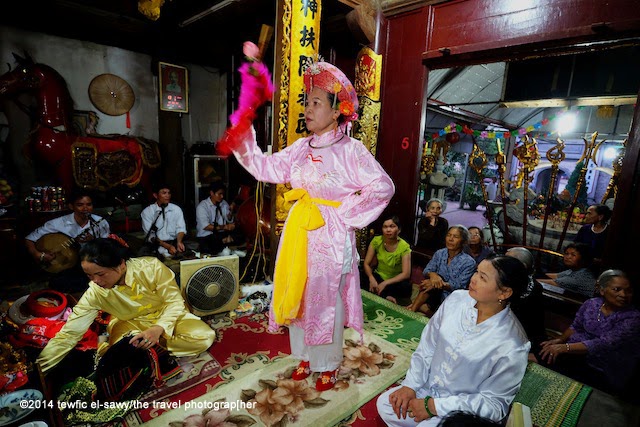
3. Hầu đồng Ceremony:


Medium in a trance. Photo © Tewfic El-Sawy-All Rights Reserved
Home run, because it's a ceremony I've never witnessed (nor heard of) before.

Hầu đồng is also known as lên đồng, and is a ritual of spirit mediumship practiced in Vietnamese indigenous religion and Đạo Mẫu, a Vietnamese mother goddess religion, in which followers become mediums for various deities.

It was by pure serendipity that we witnessed and photographed such a hầu đồng full ceremony in Bac Ha, and a rehearsal in Sa Pa. The full ceremony may last up to seven hours, and it begins with petitions to Buddha and to the deities for permission to carry out the ritual, after which the medium sits in the middle of four assistants, whose job it is to facilitate the medium's incarnation of different deities and spirits. It's a fascinating spectacle during which the medium (dressed in pink in the above photograph) chants, dances and changes in no less than 6 or 7 costumes of different colors during the ceremony.

Due to a misunderstanding, a member of our group committed a grave offense during the ceremony in Bac Ha, but a sincere apology to the temple's authorities (after which I was offered glasses of rice wine to drink to help the reconciliation along) allowed us to continue photographing. It's a testament to the generosity of the Vietnamese temple's congregation that the incident was so promptly forgiven.


4. Hội An Streets:


Photo © Tewfic El-Sawy-All Rights Reserved
Yes, Hội An is a tourist town. What can we expect from a small town recognized as a World Heritage Site by UNESCO? But setting that aside, it's a wonderfully atmospheric place with an incredible wealth of stunning backdrops for street photography, for travel photography and for fashion/model photography.

I would definitely consider staying in Hội An for a week or so. Rather than stay in the lovely and posh (but sort of generic) Hoi An Hotel, I'd stay at the Vinh Hung Hotel, an upscale but tiny heritage hotel located in the heart of town. And have Cao Lau, the local signature noodle dish  at Miss Ly every day!

It'd be wonderful to take my time...and indulge in slow street photography. In other words, pick a spot (preferably with a cup of coffee or a La Rue beer), wait and cherry-pick whatever happens in the street. As I wrote in a different post, I'd also enjoy fusing travel photography to ethnic/modern fashion photography. The style can be posed...with static portraits, or can be pseudo environmental-street portraits.
Photo © Tewfic El-Sawy-All Rights Reserved
There's no limit to the willingness of eye-catching persons, whether locals or tourists (such as the lovely Vi in the above photograph) to pose for photographers. Hội An is a magnet for newly-weds (or about to be married) who come here with their make-up artists and photographers.

Photo © Tewfic El-Sawy-All Rights Reserved
The pretty and lively bride in pink loved my suggestion that she pose under the bird cages...I told her that it'd be an appropriate setting since they were lovebirds. She left her photographer, and ran to the spot I indicated. Nothing is set up in this photograph...the brooms, the bird cages, the bicycle...all was left as is. That's Hội An.

Photo © Tewfic El-Sawy-All Rights Reserved
A bride-to-be is being dolled-up by her make-up artist, just around from the famous Japanese Bridge. It's these quotidian scenes that attract me visually to places like these. Yes, here the bride saw the photographer...but I'd wait for as long as it took to become just part of the background, and for a scene (a story) to develop.

Have I said that Hội An was a home run? If I haven't yet, then yes...it is.

5. The Tây Bắc Region:

Flower Hmong in Bac Ha. Photo © Tewfic El-Sawy-All Rights Reserved
I need to be quite emphatic about this: I resent blue tarpaulins, motorbike helmets, motorbikes and baseball caps photo-bombing my photographs.  

So no home run for the northern region of Tây Bắc, which for us mostly meant the markets of Bac Ha, Can Cau, and Coc Ly. We had to pass on Xin Cheng market due to Typhoon Kalmaegi. The exception was Sa Pa, which is a nice little town with some opportunities for street photography and ethnic photography of the H'mong.

Bac Ha market is the largest of the region, and perhaps because I had been before, it didn't have the visual umph it had when I was there in 2012. One thing for sure has changed...the area where the Flower Hmong, Dzao and others ate their breakfasts and lunches was moved by Bac Ha municipality (or whatever it's called) from the center of the market to the right of its entrance. It's now more orderly, but it removed the ad hoc feel that the market had before the move.

And because of the threatening rain, blue tarpaulins were stretched all over the stalls...giving out a rather nasty light to faces and clothes. 

That said, Bac Ha is still the granddaddy market of the region. As we had spent the night at the nearby Sao Mai hotel, we had the market almost to ourselves until 10:00 am. When the tourists arrived with their GoPro and heavy cameras, we left for breakfast.

Flower Hmong Matriarch in Can Cau. © Tewfic El-Sawy-All Rights Reserved
Can Cau Market is held on Saturdays, and is predominantly frequented by the Flower H’mong. While not far from Bac Ha, it took us about 3 hours to drive from Sa Pa. Much smaller than the Bac Ha market, it doesn't have its 'charisma'. It'd be easy to blame the humidity, but it was quite high...and it drained us of energy quite rapidly. The locals seemed to take the humidity in stride, carrying umbrellas and sometimes fans.

Flower Hmong family in Can Cau-© Tewfic El-Sawy-All Rights Reserved
Coc Ly market is held weekly on Tuesdays, and is also crowded with Flower H’mong. Only 35 kilometers from Bac Ha, the roads are quite nasty and bumpy...and were probably made worse during the rainy season. It's perched on a hillock, and it struck me as one of the least interesting. I was amused when a meddlesome American woman kept watching me photographing a very amenable Flower Hmong for a while, and then told me to stop because I was "harassing" her.

In short, there indisputably were some interesting photographs to make in these markets, but group tourism's tentacles have reached these markets, and they've lost some of their authenticity. I suspect many of the implements and products sold to to the locals are made in China...while the handicrafts presumably made by the local minorities seems to be shoddier than usual.

In a future iteration, a People of Tây Bắc Photo Expedition will continue to be based in Sa Pa but will venture to markets and villages further afield...as far as possible from tour buses, it that's possible.

6. Sa Pa:


Hmong in Sa Pa market. Photo © Tewfic El-Sawy-All Rights Reserved
I like Sa Pa. The Victoria Hotel is great...although their staff can be somewhat impersonal. But that's what happens when your guests are mostly tour groups. The restaurants are welcoming, all have free wi-fi and the food is quite good. Not as good as Hoi An...but good.

Yes, I like Sa Pa...it wasn't misty nor cool as it was in 2012, and the main square is now empty of the Hmong vendors that had taken it over in the late afternoons. They've been chased away, and given a dreary space above the market to sell their goods. Presumably to have them pay a permit fee or something like that.

Along with the group, I enjoyed doing some monochrome work in the tiny market; exploiting the chiaroscuro of its alleys, and the black dress of the Hmong as best I could. It was in Sa Pa that I also stumbled on a Hầu đồng rehearsal ceremony, which in a way prepared us for the real thing in Bac Ha.


Hoi An Lanterns. © Tewfic El-Sawy-All Rights Reserved
So what would I do differently?

If I was omnipotent, I'd change the weather. It affected the attendance of the Tet Trung Thu street festival; it prevented us from attending the least touristy market in the northern region and it exhausted us.

But within my direct control, I'd reduce the number of days in Hà Nội and increase the stay in Hội An. I'd still stay in Sa Pa, spend a day in Bac Ha, but travel much further in search of traditional small villages that are not on the tourist trail.

Red Dzao in Ta Phin. Photo © Tewfic El-Sawy-All Tights Reserved
Now, the finale for the those who like statistics. My estimated usage of my cameras was as follows:
Fuji X-T1 + Zeiss Touit 12mm f2.8: 75%
Fuji X-Pro1 + Fujinon 18mm f2.8 : 10%
Leica M9 + Voigtlander 40mm f1.4: 15%

(I used the Fuji Zoom XF18-135mm f3.5-5.6 for the fishermen photo shoot, and another time in Hà Nội 
around Hoàn Kiếm lake.)

Did I miss my Canon 5D Mark II and my panoply of primes and zooms? 

No. Not once.

Friday, 26 September 2014

30,000 Feet In The Air | Thoughts

Ms Hiền Trang in Hoi An street. Photo © Tewfic El-Sawy-All Rights Reserved
At just over 8000 miles, the Cathay Pacific flight from Hong Kong to New York is one of the longest direct flights, and it gave me ample opportunity to use my jet-lag addled brain to toss over ideas about The People of Tay Bac Photo Expedition-Workshop.

In between in-flight movies and meals...and possibly over the polar cap, I concluded that one of the most enjoyable segments of the photo expedition (for me) was the so-called "fashion" photo shoots that either happened serendipitously or by design in Hoi An and in Ha Noi.

I enjoyed these so much that I am seriously giving thought to dedicate a few days during in a forthcoming trip to Vietnam to such "fashion" shoots....fusing travel photography to ethnic fashion photography. The style can be posed...with static portraits, or can be pseudo environmental-street portraits such as the one above.

Ms Hiền Trang in Hoi An doorway. Photo © Tewfic El-Sawy-All Rights Reserved
It's a totally different change of pace. It takes a combination of various skills...some of which I have, and others that I still don't...but that are more or less easy to acquire. To really do a professional job, I'd need the support of models, local photographers (many such photographers are available in Da Nang, Hoi An and Ha Noi), as well as make-up artists....and finding a handful of attractive local dresses.

In Hoi An, I was fortunate to have had the generous support of the adorable Hiền Trang, and of professional photographer Minh Nhat Nguyen. I also stumbled on Mai Đoàn, who could provide the make-up support if required.

Scouting for attractive backdrops is not difficult in Hoi An. The little town is replete with those, including the interiors of the Chinese Assembly halls. Many stores have ancient fronts that offer superb backgrounds, along with mustard yellow textured walls for which the town is famous for.

Ms Hiền Trang in Fujian Assembly Hall. Photo © Tewfic El-Sawy-All Rights Reserved
If these thoughts come to fruition, I'd have to acquire the proper accessories such as reflectors and strobes, which I haven't used much before. However, these accessories would have to be minimal so as not to require photography permits, and to avoid red tape.

We scheduled a photo shoot with Hiền Trang at the Fujian Assembly Hall. This landmark was built around 1690 for the Chinese ethnic group from Fujian to socialise, but later it was transformed into a temple dedicated to the Fujian deity named Thien Hau, the goddess of the sea.

Source: Heritage (Vietnam Airlines Flight Magazine) 

The inspiration for Hiền Trang's photograph at the Fujian Assembly Hall was from images featured in Vietnam Airlines Flight Magazine. One of our group members, Maria Dikeos, spotted the resemblance in the setting, and suggested we held a photo shoot in that particular corner.

Another project to plan for, and to look forward to during 2015.

And yes. All these photographs were made with the new Fuji X-T1, and a Zeiss 12mm f2.8

Tuesday, 23 September 2014

Ha Noi | Report 11 | The People of Tay Bac

Photo © Tewfic El-Sawy-All Rights Reserved
All good things come to an end. Sort of.

The People of Tay Bac Photo Expedition ended at breakfast this morning (Ha Noi time), where it has become noticeably cooler and less humid.

Seizing on the opportunity to shoot in the streets without exuding a ton of sweat, I worked the small streets of Hanoi and its tiny alleys, where impromptu small pho establishments suddenly appear out of nowhere. I've been encouraging the group to look for layers in their street photographs, and I practiced what I taught.

Ha Noi's Old Quarter is rife with such opportunities, but one has to pick an interesting spot and wait...or lucky enough to stumble on one or more of such scenes. I normally shoot from the hip in such instances; not because I don't want to appear sneaky but because I don't want the subjects to freeze, or wave, or proffer the V sign that's very popular in Asia.

Mostly working with my new Fuji X-T1, (and occasionally with a Leica M9), during the past couple of weeks convinced me that the era of DSLRs for me is over. The X-T1's capabilities, performance, ergonomics as well as image quality, are very impressive. It has a few quirks and irritants, but these are easily either ignored or worked around.

In a few days, I'll write up a review about the Fuji X-T1, and feature it here on this blog.

Sunday, 21 September 2014

Hội An | Report 10 | The People of Tay Bac

Ms Hiền TrangPhoto © Tewfic El-Sawy-All Rights Reserved
Undoubtedly, Hội An is now a tourist haven but it still is a wonderful little town, with a myriad of photo opportunities whether candid, serendipitous, posed or set up. Its ancient town is an exceptionally well-preserved example of a South-East Asian trading port dating from the 15th to the 19th century. Its yellow textured mustard walls are an ideal backdrop for photographs, and some of us took advantage of that feature. Even its plentiful restaurants seem to have an interesting ancient history to them.

The group's assignment in the streets of Hội An was to try to emulate the chiaroscuro style of Alex Webb...but unfortunately, while it was sunny (and humid), the sun's angle didn't cooperate. There was however, alternatives that occupied us the too few days here.

Photo © Tewfic El-Sawy-All Rights Reserved

Our day started at 4:00 am, when we boated to the mouth of the Thu Bon River to photograph the large fishing nets (reminiscent of the Chinese nets in Cochin). These large contraptions are lowered into the water to catch fish during the night. They are slowly raised and lowered by the fishermen using foot-powered winches.

I had booked a morning boat through Dang Ke Cuong, a talented local photographer who I had met on my previous stay in Hội An two years ago, and whose images of similar fishermen are wonderful.  The setting was just splendid, and the sunrise happened on cue and cooperated fully. Most of us either ran out of batteries or storage space in their cameras during this outing, which included time at the fishing wharf a few miles from Hội An itself. There the activity was frenetic, and the buyers of fish (that ended on the restaurants tables) were relentless arguers and hagglers.

Photo © Tewfic El-Sawy-All Rights Reserved
As I wrote above, the streets of Hội An are rife with photo opportunities; some contrived and others not. Elderly ladies are largely ambivalent about being photographed, and some require some coaxing to allow it. This elderly lady was quite happy to be photographed in front of what I thought was her restaurant. She must've been quite a beauty in her days, and I could easily imagine her in an ao dai, being courted by eager young men.

Speaking of which, I am extremely fortunate to have finally met with the adorable Ms Hiền Trang (top photograph), who was willing to pose for our group in various interesting places in Hội An. Accompanied by her friend, photographer Minh Nhat Nguyen, who acted as photo shoot director, we spent two hours emulating fashion photographers in the field. Not perhaps the purview of travel photographers per se, but a worthwhile exercise fusing exotic location photography, fashion photography with travel photography.

The day ended with dinner at a local restaurant (not a tourist trap by any means) where cau lay and squid dishes...and La Rue beer, of course.

Photo © Minh Nhat Nguyen-All Rights Reserved


Friday, 19 September 2014

Ha Noi | Report 9 | The People of Tay Bac

Photo © Tewfic El-Sawy-All Rights Reserved
The group's morning assignment was ostensibly a simple one; during a single photo shoot, and in 15-20 photographs, show Hanoi's teeming life in its streets.

However, the assignment was to be in monochrome. Not as simple as initially thought, eh? Especially with Ha Noi's Old Quarter vivid colors and textures, and particularly galling because of the wondrous light that appeared after every thundershower.

The other objective of the assignment was to encourage the participants to see and capture  "layers"...the fundamental attribute to successful street photography...and to record ambient street noise/sound to accompany the photographs. It was up to them whether to shoot from the hip or otherwise.

I chose to feature the above photograph in monochrome and color...to provide a contrasting view of the same image, and leave it to the viewers as to which they prefer. Both have different aesthetic merits, and both are faithful in their depiction to what I saw. The photograph was made by shooting from the hip so as not to disturb the woman.

By the way, she is playing Candy Crush on her Apple iPad.

Thursday, 18 September 2014

Lào Cai-Ha Noi | Report 8 | The People of Tay Bac

On The Lao Cai-Hanoi Road. Photo © Tewfic El-Sawy-All Rights Reserved
The itinerary has us today returning from Lào Cai city, the capital of Lào Cai Province. It borders the city of Hekou Yao Autonomous County, in the Yunnan province of Southwest China, and the Chinese influence is quite pervasive. The beautifully appointed Swiss-Bel hotel was virtually empty of guests, except for a handful of local Vietnamese, and us being the only non-Asians. Our Ha Noi minder Huyen rode an overnight train to take us back, and to solve any issues if we had any during our return trip.

The journey back to Ha Noi took us from 09:30 am to about 5 pm, door to door. A middle section of the highway is still blocked off due to last minute repairs, but the toll gates are open and we drove on this new highway for quite a while. The back roads were in bad condition due to the rain caused by the typhoon, but I've seen much worse.

On the way, we stopped to photograph the rice harvest in the gorgeous paddies, and chanced on a small house where these elders were tending to their grandchild. There was some reticense after this photograph was made because traditional Vietnamese normally do not like to be photographed in threes (and/or other odd numbers).

Ha Noi felt like home. The chaos, the commotion, the noise...and naturally the lip-licking Pho Bo at  Pho 10 on Lý Quốc Su street. A bowl of pho bo and a bottle of Hanoi beer set each one of us 60,000 dongs or just under $3.00. It really can't be beat.

Wednesday, 17 September 2014

Coc Ly | Report Seven | The People of Tay Bac

Coc Ly Market. Photo © Tewfic El-Sawy-All Rights Reserved
I had not been to Coc Ly market before, so yesterday's morning's excursion was somewhat of a novelty. Coc Ly Market is held weekly on Tuesdays, and is predominantly frequented by the Flower H’mong. While only 35 kilometers from Bac Ha, it took us about 3 hours to drive from Sa Pa. It's smaller than the Bac Ha market that's held on Sundays, and doesn't have its 'charisma'.

Sa Pa Market. Photo © Tewfic El-Sawy-All Rights Reserved

Returning to Sa Pa, after a quick lunch of Pho Ga and Bun Cha in Lao Cai, we were out for an afternoon of street photography. A drizzle was starting to develop; auguring heavier downpour in the evening. Unknown to me at the time, but Typhoon Kalmaegi would soon arrive to the north of Viet Nam, drenching the north.

In contrast to the ambulatory photography style I adopt while at the markets, I spent the afternoon in the Sa Pa market in one or two locations.  I chose a spot where I thought there'd be interesting foot traffic...adjust my settings,  pre-focus my camera (I used the Leica M9) and wait patiently for some interesting scene to develop.

Note: Typhoon Kalmaegi did indeed hit the region and I had to cancel our trip to Xin Cheng market due to reported landslides, heavy downpours and muddy terrain which could have made the trip unfeasible for our van.  Currently in Lao Cai at the Swiss Bel hotel...a new, modern and posh hotel, where we probably are the only residents.

Tuesday, 16 September 2014

Sa Pa & Ta Phin | Report Six | The People of Tay Bac

H'mong in Sa Pa. Photo © Tewfic El-Sawy-All Rights Reserved
Yesterday included a morning of street photography in the small town of Sa Pa. Being such a small place, it was not too difficult to grab an interesting street scene, provided the Black Hmong vendors left us in peace.

Since much of the pedestrian action really occurs on a couple of small streets, as well as on the steps leading to and from the central market, it was easier to station myself at a specific point on these steps, and wait for something or someone interesting and exotic to happen by. Using the Leica M9, I pre-focused and chose the most appropriate settings...and just waited.

A word about the Hmong vendors. They have (for the most part) a sense of humor, and very willing to exchange banter with tourists. They are rather persistent in trying to buy some of their handicraft, but once they realize there's no way, they either walk away to look for another prey...or exchange pleasantries with anyone who'll give them the time of day.

Ms Thuy Linh, Sa Pa store owner. Photo © Tewfic El-Sawy- All Rights Reserved
Whilst waiting for interesting scenes to develop, I noticed an attractive store vendor watching me, and who seemed to understand the purpose of my being there. Expecting nothing much of importance to develop over the next few minutes, I asked if I could photograph her. Thuy Linh (her name) readily accepted, and naturally asked me to send her images when I was done.

The reason I mention this is that this exchange between two people who don't speak each others' language couldn't have occurred a few years ago.

Using Google Translate app on my iPhone, I asked her if I could photograph her, and if she had an email. She asked me to send the images to her Facebook account, and became my Facebook friend on the spot (using an iPhone no less)...enabling me to accept her invitation and eventually send her the images.

Red D'Zao. Ta Phin. Photo © Tewfic EL-Sawy-All Rights Reserved

In the afternoon, we drove to the village of Ta Phin, a picturesque thirty minute drive north of Sapa. It's about 17 kilometers to the west of Sapa, and is principally a Red Dao village, where these can be seen embroidering their wares for sale to tourist groups.

On the way to Ta Phin, we stopped at the abandoned French nunnery/monastery. It was built in 1942, but was promptly evacuated and deserted by 1947. Its walls are in ruins but are covered by mustard-color moss (or lichen), giving it a wonderful textured look.

Photographing a bunch of Red Dao women in the village itself was not too difficult...despite their relentless efforts to make us buy anything from their inventory. It would not have been possible to persuade a couple of them to accompany us back to the French monastery where they could've been photographed against the interesting walls.

Sunday, 14 September 2014

Bac Ha | Report Five | The People of Tay Bac

Photo © Tewfic El-Sawy-All Rights Reserved
Rather than rising pre-dawn to drive from Sapa to Bac Ha in order to reach its famous Sunday market early, I structured the itinerary in such a way that we spent the night at the Sao Mai Hotel. Naturally, Bac Ha being a weekend destination for most tourists, the Sao Mai Hotel is the best there is in the small town...which doesn't mean much. That's said, its location is extremely convenient as it's only a couple of hundred meters from the Bac Ha market.

Once again, I took a walk along the streets of Bac Ha late afternoon Saturday, and wafts of religious chants emanated from a small temple. Asking around, I was told it was a hầu đồng ceremony, but I couldn't get firm information as to when it'd be over or how long it was to be performed.

Rushing back to the Sao Mai, I gathered the rest of the group and we photographed the ceremony  until late at night. Before describing what hầu đồng is, I must express my utter amazement and gratitude to the local Vietnamese congregants at this temple who welcomed us with open arms, and showered us with their tolerance.

Hầu đồng, also known as lên đồng, is a ritual of spirit mediumship practiced in Vietnamese indigenous religion and Đạo Mẫu, a Vietnamese mother goddess religion, in which followers become mediums for various deities. The main ritual, which may last from two to seven hours, begins with petitions to Buddha and to the deities for permission to carry out the ritual, after which the medium seats him or herself (both men and women may act as mediums) in the middle of four assistants, whose job it is to facilitate the medium's incarnation of different deities and spirits. (Wikipedia).

Although we were restricted by the temple's small space, I managed to photograph at will until I ran out of SD card space. I also recorded the live performance by the musicians; music that accompanied the medium as she went through the various incarnations. The live recording was badly affected by the small space of the temple and the resultant reverberation of the percussion and the gong.


Photo © Tewfic El-Sawy- All Rights Reserved
It was a pre-breakfast short walk to the Bac Ha market early morning Sunday, where the villagers had already arrived and spread their products to sell. It looked somewhat different than how I remembered it, and May Lan (our H'mong minder) agreed. The local authority had moved the eateries down to the entrance of the market.

That early, we were the only non-local people around....but I knew it wouldn't last long when tourist buses would arrive. There were mostly Flower H'mong, and a few Black Dzao, and Tay. The animal market was especially busy, with buffalos being bought and sold (one sells for about 30 million dongs or $1500...not much). A few local tribespeople were selling puppies and small dogs....whether for pets or otherwise.

Engaging the women vendors without buying any of their wares is not too difficult. Many of them have a very keen sense of humor, and are willing to have fun and be teased. A few are dour, and don't respond to bantering, and a few genuinely don't like to be photographed. Older women cover their faces, not because they don't want to be photographed for cultural reasons, but because -as they told May Lan- they were too old and had lost their beauty.

Just at the entrance to the market, there's a small restaurant where we had breakfast. It seemed its Pho Ga was the best some of my group had ever had.


Friday, 12 September 2014

Sa Pa | Report Four | The People of Tay Bac

Photo © Tewfic El-Sawy-All Rights Reserved
It took us far longer than expected to drive from Hanoi to Sa Pa, the famous hill station in the north of Viet Nam. The brand new highway is supposed to cut the journey time from approximately 10-12 hours to a mere 4 or so, but because a section was closed for repairs, we had to take the back roads, and reconnect into it not too far from Lao Cai....so we did it in about 8 hours.

Sa Pa is still humid (in comparison to two years ago, when it was really cool at the same time of the year), but it's tolerable. Accompanied by our Hanoi minder Huyen, and now Lan...our new Hmong guide in Sa Pa (and beyond), we explored the market area. The vendors have quieted down from what I recall, and there are less of them hassling the newcomers.

At one point, I heard unmistakable religious music emanating from a nondescript building, and asking around, I was told it was a temple. I walked in and encountered a handful of women dressed in red traditional clothes who, through sign language, told me that a ceremony would start at 9:00 am.

Religious music and ceremonies are like catnip to me...and I decided to forgo the street photography morning in its favor.

Rustling up the rest of the group wasn't an easy matter as they had dispersed around the area, but we finally found ourselves welcomed to the temple by around 15-18 women wearing these red outfits.

Photo © Tewfic El-Sawy-All Rights Reserved

It appeared that it was a rehearsal for a much larger ceremony which was to occur tomorrow. Naturally, we will be on our way to Bac Ha by that time, so we thanked our stars to be able to catch it.

Despite our being occasionally in the way,  the congregants were extremely gracious and didn't seem to mind us at all...quite the opposite. In short, this photo shoot (once again, serendipitous) was an enormous success for all of us.

Technical porn snippet: The Fuji X-T1 performed flawlessly. The X Pro-1 showed its age.

In contrast, our afternoon photo shoot to the village of Cat Cat, described as an age-old village of H’Mong ethnic group, was an immense flop of monumental proportions. If you fancy walking (actually quite an arduous trek) in the company of busloads of tourists, then go....but this was an epic fail. I'm not going to waste one sentence on it.


Wednesday, 10 September 2014

Hanoi | Report Three | The People of Tay Bac

Photo © Tewfic El-Sawy-All Rights Reserved
The current high humidity prompted me to set aside our Hanoi street photography program, and flee with the group to the equally humid (but less crowded) village of Tho Ha village, about 45 kilometers from the capital city. Tha Ho village's claim to relative fame is in it's specialization of producing rice paper, used for spring rolls and other Vietnamese culinary dishes.

Serendipity played its role in us passing by a row of old houses, and meeting Việt. Our minder, Huyen, asked permission to enter his house where he welcomed us with remarkable hospitality, offering us rice wine in small goblets... quite potent at this time of the day.

Seeing a collection of traditional instruments on his living room's walls, I asked if he played them...and he said yes. Being encouraged to play, he grabbed one these stringed instruments and started singing a number of traditional Vietnamese songs, and entertained us for over an hour. Naturally, we whipped out our cameras and audio recorders.

As soon as I realized Việt's talents, I thought I'd suggest him as being the subject of the group's first multimedia assignment. Ten photographs and a snippet of his music playing in a short multimedia project would be the group's initial homework.

Photo © Tewfic El-Sawy-All Rights Reserved
What other news? Well, I was asked by the owner of the Golden Silk Boutique Hotel (a lovely hotel perfectly located in Hang Gai) to make some photographs of her at the hotel...a request that I jumped at. I didn't expect any, but she gifted me a lovely scarf in return. She probably realized my affinity to scarves, and chose one that is really luxurious. It'll certainly not be used during my photographic travels.

Oh, and by the way...the best Pho Bo I've ever had (and this is shared by the rest of my group) is at a modern restaurant on Ly Quoc Su...a short walk from the hotel.

Tomorrow, we travel to Sa Pa and it was with considerable relief that we received confirmation that there's a newly constructed road linking Hanoi to Sa Pa. No trucks are allowed so the travel time has been cut from 10-12 hours to a mere 5.

Monday, 8 September 2014

Hanoi | Report Two: The People of Tay Bac

Photo © Tewfic El-Sawy-All Rights Reserved
The humidity is just staggering in Hanoi, and it's certainly affecting the group and I. Timing the photo shoots in the early morning, as we did today, doesn't really make a measurable difference.

That said, the dawn-early morning walk about on the Hoàn Kiếm Lake shore was interesting, both culturally and photographically. Apart from the placid tai chi being performed by Hanoi's senior citizenry, the group and I came across a more energetic display of the form using large fans, couples dancing to the tune of Delilah probably performed by a Vietnamese Tom Jones, groups of women of all ages doing aerobics to the bear of disco music...and school children waiting for their buses.

Later, we went for another walk about on Hang Ma...the epicenter of the Tết Trung Thu festival; the Mid-Autumn Festival, which is the country's second most important holiday, after Tet, the Vietnamese New Year.

It's a combination of Christmas, Halloween and a block party of sorts during which young women (known as 'the pretty young things' in my parlance) wear Minnie Mouse ears and huge eyeglasses (fake), and flash the ubiquitous Asian 'V' sign at whoever looks at them.

It's a surfeit of sensory overload, with incredibly colorful decorations and lanterns...as well as incessant traffic noise caused by an endless stream of motorbikes and scooters.

Photo © Tewfic El-Sawy-All Rights Reserved
I anticipate that Hang Ma will really be incredibly crowded this evening when we return for another dose of the Mid-Autumn Festival...hopefully this time, there'll be dragon dances!

By the way, the technological improvement of the X-T1 over the X Pro-1 are really staggering. The latter is really showing its age...however, I'm still using both.

Thursday, 1 May 2014

The Birth of Color | When Krishna Met Radhe


I'm pleased to feature my photo essay titled The Birth of Color-When Krishna Met Radhe with more than 20 "full-bleed" color photographs of the festival of Holi in Vrindavan and Mathura. I chose to publish this 'sampling' of photographs on Exposure, one of the photo-narrative portals that is designed to give photographers space to publish photo essays. Some of these images and others will also be published on my website.

These photographs were made during my recent The Sacred Cities Photo Expedition-Workshop to Varanasi and Vrindavan. We spent around a week photographing the festivities of Holi in Mathura and Vrindavan and in retrospect, it was one of the most difficult photo expeditions-workshops to operate due to the chaotic nature of the festival, and other factors which I address in more details here.

Part of the title to this photo essay is obviously inspired by the movie When Harry Met Sally...an iconic movie if there was ever one. There's no direct link with the movie's story, but I thought it was a catchy title. In fact, the festival of Holi is based on a number of legends; only one of which is based on the love story between Krishna and Radhe.

Producing an audio-slideshow of Holi is quite difficult because of the disparate events that took place whilst we were there. Particularly difficult is the editing that will have to go into producing a coherent audio track.

Photo © Charlotte Rush-Bailey-All Rights Reserved

Seeing the imagery I returned with, I now think whatever happened to me: getting whacked on the elbow by stick-wielding out-women during one of Holi's 'rituals', getting smothered with color powder or doused with colored water, was really worth the trouble.


Wednesday, 23 April 2014

Ruben Vicente | Varanasi Ganga Aarti


Ruben Vicente was a member of my The Sacred Cities Photo Expedition-Workshop last month which saw us photographing in the ancient city of Varanasi, and in the sacred city of Vrindavan during the festival of Holi. He is a first time participant in my expeditions-workshops.

Ruben just published his first multimedia project of the photo expedition-workshop, and titled it Varanasi Ganga Aarti. The multimedia features photographs of the nightly religious ceremony, which is held on the banks of the Ganges, on the most popular ghat; Dashashwamedh Ghat.

The aarti is a devotional nightly ritual that uses fire as an offering, usually made in the form of a lit lamp, and in the case of the Ganges River, small "boats" with a candle and flowers is floated down the river. The offering is made to the Goddess Ganga, goddess of the most holy river in India.

Ruben tells us on his own blog that because of the awful artificial light illuminating the ceremony, he decided to convert his photographs to black & white. He recorded the audio on location, and despite the amplification distortion, managed to produce a compelling audio slideshow. I described one of his images of the pandit gesturing with incense sticks as magical...

See if you agree.

Ruben Vicente is travel photographer based in Lisbon who, apart from loving photography, is an IT consultant in the financial industry.

Thursday, 3 April 2014

Anthony Pond | Ganga Aarti


Anthony Pond was a member of my The Sacred Cities Photo Expedition-Workshop a couple of weeks ago during which we photographed the eternal city of Varanasi and the sacred city of Vrindavan during the festival of Holi, and is a second time participant in my expeditions-workshops.

He just completed his first multimedia project of the photo expedition-workshop, and titled it Ganga Aarti. The lovely photographs are of the nightly religious ceremony held on the banks of the Ganges. The aarti is a devotional ritual that uses fire as an offering. It's usually made in the form of a lit lamp, and in the case of the Ganges River, a small "boat" with a candle and flowers is floated down the river. The offering is made to the Goddess Ganga, goddess of the most holy river in India.

Rather than using Soundslides and Audacity. Tony chose to process his photographs in Lightroom and Silver Efex Pro, and built the slideshow movie using Final Cut Pro X. Setting aside the fact that Tony is an aficionado of black and white photography, converting his photographs to monochrome eliminated the difficult lighting conditions that afflicted photography during the ceremony.

Anthony Pond worked for more than two decades in the criminal courts in California as an attorney for the Public Defender’s Office. Now pursuing his passion for travel and photography, he travels repeatedly to South East Asia and India, amongst other places, to capture life, the people and the culture. He has been a frequent contributor to The Travel Photographer blog,

Wednesday, 2 April 2014

POV: Why Wasn't I Thrilled With Holi? Why No Fuji X Pro1?

Photo © Tewfic El-Sawy- All Rights Reserved
On my return from The Sacred Cities Photo Expedition-Workshop last week, a handful of readers asked me these questions:

1. Why wasn't I more thrilled with photographing the Holi festivities in Vrindavan and Mathura?

2. Why haven't I used the Fuji X-Pro1 more often (only an estimated 10% of the time)?

Well, I certainly was excited to photograph Holi, particularly as the pink/fuschia, yellow and neon green powders being thrown in the air, smeared on people's clothes and faces made for compelling color (and possibly monochrome) photography. However, something was missing....and I knew that that something would be missing much before traveling to India.

The large majority of my photo expeditions are event-specific; whether it's to photograph the mind-blowing annual death commemoration of Sufi saint Moin'uddin Chisti in Ajmer, the bloody rituals of Velichapadus in Kerala or large Ngaben (cremations) in Bali. These events are usually religious and spiritual, and masses of people attend them to express their devotion and faith.

The festival of Holi had little evidence of that. Holi is a festival of Spring, of reconciliation, of exuberant fun, to celebrate the advent of a new season. Its religious 'ancestry' has been largely forgotten, and secular festivities have taken it over. While the throwing of colors seem to have some original religious significance, it's now an opportunity to 'frolic' as some of my Indian friends describe it.

Avoiding excessive colored gulal being thrown directly at me prevented from entering in what I call my "deep zone".. This the frame of mind that I get into when I photograph...sort of being sucked into a different dimension where I only see what I want to photograph....a sort of complete immersion. That was generally not possible during Holi. Only for a few moments in the 'mosh pit' of Vrindavan's main temple, Bank Bihari, did I achieve that...oblivious of the chaos around me, and focusing on what I wanted to photograph.

Outside of the Banke Bihari temple's courtyard, where expressions of faith and devotion were aplenty, I saw no religiosity whatsoever...aside from tapestries depicting Krishna and Radha, and devotional songs blaring from roadside shacks.

That's why I wasn't thrilled photographing Holi as much as I was buzzed to photograph the religious events I mention earlier. As I said in an interview, "it's religious rituals and ceremonies that attract me the most for my photographic work because it’s where people are at their most authentic, where there are no artifices and no make-believe. It is at these events that one connects with humanity at its basic denominator, and with the nobility of the human spirit … and it is that that nourishes me, and I try to share that with others."

It's that simple.

As for not using the Fuji X-Pro1 more often. It's a good question. I thought about that, and conculded it was a combination of needing the speed of the DSLRs and their being better sealed. Before traveling, I fashioned a waterproof cover for the X Pro-1 out of a Zip-Lock bag, and while it seemed to be more than adequate, I was reluctant to put it to the test.

It's that simple.

What I do regret very much is that I didn't use my iPhone during Holi...I didn't want to risk it being stolen in the crowds.


Thursday, 27 March 2014

The Sacred Cities: Varanasi & Vrindavan Photo Expedition | The Verdict

Photo © Tewfic El-Sawy-All Rights Reserved
I don't know if other photographers who lead similar tours do it, but my readers probably know, I self-grade my photo expeditions-workshops, and go public with my verdict. From experience, I'm usually more critical than group members...so for those with limited time to read all about the what worked and didn't work, here are two short paragraphs that summarizes it:

My overall grade for The Sacred Cities: Varanasi & Vrindavan Photo Expedition-Workshop is 65%. Visually, the photographs of Holi events are mouth-watering, however the festival has lost its original religiosity to a great extent. It was only within the courtyard of Banke Bihari temple that I saw -and photographed- authentic and immersive devotion, and religious fervor. Otherwise, Holi was as religious as La Tomatina festival in Valencia.

My camera usage: Canon 5DMk2 with 17-40mm (75% of the time). Canon 7D with 70-200mm (10%). Canon 5DMk2 with 24-70mm (10%) and Fuji X Pro (5%).

For the detailed review:

Yes, my overall grade is lower than my expectations by about 20 basis points. So why such a low grade? Let me start with the Vrindavan negatives first:

1) Holi as a festival: The mix of Holi as a chaotic festival that called for precautionary measures to protect (as much as possible) ourselves and gear from over-the-top color powder and water throwers, the huge unpredictable surge in crowds, and an utterly useless local guide, all contributed to lowering the grade.

Having to protect our gear with various iterations of rain cover (whether common Zip Lock bags or more sophisticated products) made it difficult to compose and choose appropriate settings....at least when we were in the midst of the activity. It was therefore frustrating to some of us to rely on "grab-shots"...which success percentage rate is understandably lower than if we had enough time and space, and weren't threatened by fiendishly accurate goswamis armed with  "military-style" water cannons or well intentioned revelers with gobs of powder color aka "gulal" smearing our faces with it.

Yes, it's what Holi is all about...but it ends up affecting the quality of the photography. While the scenes at Banke Bihari Temple, the epicenter of Holi devotional revelry in Vrindavan, provide incredibly compelling photographs of devotees covered in color (see top photograph and the raw unedited movie clip below), these were also repetitive and most of us hit the point of diminishing returns after the second or third visit.

There were occasional crowd surges which, if one was unsteady on his/her feet, could've been a problem. On two occasions, we were in the midst of these surges but survived to tell the tale.


Photographically, unless we were in what we called "the mosh pit", the photographs made from the side of the temple, or from its side balcony were uninteresting, and repetitive. How many photographs can one make of the crowds throwing pink or green "gulal" at the deity...even if using a 70-200 to capture expressions, and photogenic top of heads? Not many.

However, the groups of Asian photographers did try to monopolize the balconies and largely stayed there, merrily click away their camera like machine-guns....subsequently perhaps enlarging and cropping their resulting photographs. But we are not wired that way...and we preferred venturing in the courtyard where the frenetic activity was...where the photographs were...but also where we were most at risk from the Holi weaponry.

At one point, having secured positions (notice the military-like language) on a raised platform to the side of the courtyard, one of the priests chased us away with his high-powered color water-thrower, soaking us all. So the safety of our gear was a preoccupation, and we were somewhat restricted in how we photographed. I don't think our photography suffered that much, but it could've been better if there weren't water nor powder...but that wouldn't be Holi.

We greatly enjoyed street photography in Vrindavan during Holi, and had to remain on the alert for the young boys who ambushed us with water balloons and water guns...however, when we told them we had cameras, the large majority of them understood and let us through...dry.

2) The Local Guide: I'm not going to waste a rant about this fellow...beyond saying he was totally useless beyond getting us to where the various festivals were....and that's being charitable. We were had a couple of reliable drivers, and one of them acted as an impromptu guide when we needed support.

3) Widows: I photographed the widows inside their ashrams some years ago, but we were unsuccessful in getting access to photograph this time. The widows themselves vituperatively shooed us out when they saw us walking in with cameras. It seems that some High Court in India prohibited photography inside the ashrams...probably because of the negative coverage that circulated then.

Photo © Tewfic El-Sawy-All Rights Reserved

4) Cluster F..ks: This is slang for the clustering of photographers surrounding a subject....shooting all at once, and shouldering each other to get a better vantage point. We had many of those in various temples...especially if a spectacularly colored person or groups appeared on the scene. Asian photographers met on this trip seemed to have a different understanding of personal space...and thought nothing of taking my place if I moved an inch away from it. It also appears from my on location observations that these particular regimented Asian photographers "chimped" in unison.

The above photograph must appear in at least two dozen photographers' inventory of images from Holi. I was surrounded by that many of them, each yelling directives to these men to hold their hands is such a way, etc.

Seriously though, most of my photo expeditions-workshops are to religious or secular events that are either unknown to photographers or uninteresting to them...and that's the way I like it. Holi is such a widely known event (perhaps more so than the Kumbh Mela and Pushkar) that crossing paths with other groups of photographers was unavoidable. It doesn't mean that I like it.

5) No iPhone Photography: I regret having been unable to use my iPhone to photograph during Holi events as these were rife with pickpockets. One of my group was relieved of a small amount of money in the Lathmar Holi event in Barsana, and a friend almost lost his mobile phone in the Banke Bihari madness.


6) Multimedia Workshop Verdict: I left this for last, because it was one of the worst results I've had since I added this module to my trips. Only one participant completed the assignments given to the group. The assignments were for 1 minute audio-slideshow from Varanasi, and a 3 minute audio slideshow of Holi. Bob Newman (seen at my right in the above photograph) was the only photographer who graduated from the module with his two multimedia projects on Widows (in Varanasi) and Holi. While most of the rest of the group have produced audio slideshows already (either independently or on my other trips), the fact remains that this was not a success.

In fairness, we didn't have enough time set aside during this trip to produce such projects. I shall restructure my future itineraries keeping this flaw in mind.

7) Illness, Accidents etc. : Aside from minor Delhi bellies and colds, the trip was relatively free of illnesses. Two accidents occurred; a nasty fall in the Varanasi alleys required the attention of medical staff, and a cow or bull in Vrindavan mistook another of our members as an obstacle, and bumped it rather violently out of its way.

And now for the positives:


1) Holi Photography: Unrivaled color (and monochrome) photography is there for the taking. Indians are some of the most welcoming people for photographers, and we weren't denied whatever photographs we sought. I had read reports of inebriated hooliganism, but while there were some young men clearly having had too much, we weren't in the least bothered.

There's no question that the best of the Holi events were those in smaller venues. The Banke Bihari temple and  Krishna Janambhoomi Temple were literally war-zones, and photographers looked and acted like war photographers in a tear gas zone.


2) The 'Yatra' Trail Around Vrindavan: Every day at dawn and even earlier, dozens of devotees and pilgrims walk along the circumference of Vrindavan, muttering prayers with the help of their rosary beads. Some of those devotees are Westerners, presumably belonging to ISKCON or similar, who also take part of this daily ritual. We walked towards Vrindavan's ghats, meeting the pilgrims along the way, and it was particularly misty and foggy. The light was just glorious at this time of day. I devoted a whole gallery of black and white photographs in the gallery Vrindavan In Monochrome.

2) No Cameras Were Harmed: No one in the group suffered damage to their cameras as a result of Holi's powder or water. We were well prepared. That said, most of the alarmist feedback we received from other photographers were just that...a tad alarmist. I saw camera protection ranging from expensive casings to cellophane wrap...and occasionally, nothing at all.

3) Vrindavan Logistics: We stayed at the Nidhivan Hotel & Resort, and despite it being a vegetarian and no-alcohol establishment (Vrindavan is a vegetarian and dry town), it's new, modern...and its staff extremely amiable and friendly. The is where most of large photography tours from Taiwan, South Korea and Bahrain-Kuwait stayed. When we craved non-vegetarian food, we traipsed to the Radha Ashok Hotel in Mathura. Having two vehicles, a bus and a passenger car, gave us some flexibility during the Vrindavan stay.

As for the 4 days in Varanasi, my grade would be more like 75%.

Photo © Tewfic El-Sawy-All Rights Reserved
Aside from the photogenic (but unauthentic) sadhus who grace the Varanasi ghats with their presence, this ancient city offered phenomenal street photography opportunities in its endless narrow alleys (known as gallis). Our group spread out amongst these alleys, capturing the scenes of life of the city.

Our on-site research indicated that aghori sadhus are generally reclusive, and it confirmed my suspicions that the photographs that we had seen of these so-called cannibalistic sect members were, in fact, of "actors"... regular sadhus with dreadlocks holding skulls and other macabre artifacts, and who supplement their meagre takings by posing for photographers.

In summary; would I do Holi again? No. Would I do Varanasi again? Absolutely.

NAKBA : Day Of Rememberance

  Nakba, meaning "catastrophe" in Arabic, refers to the mass displacement and dispossession of Palestinians during the 1948 Arab-I...