Showing posts with label Indonesia. Show all posts

Wednesday, 30 May 2018

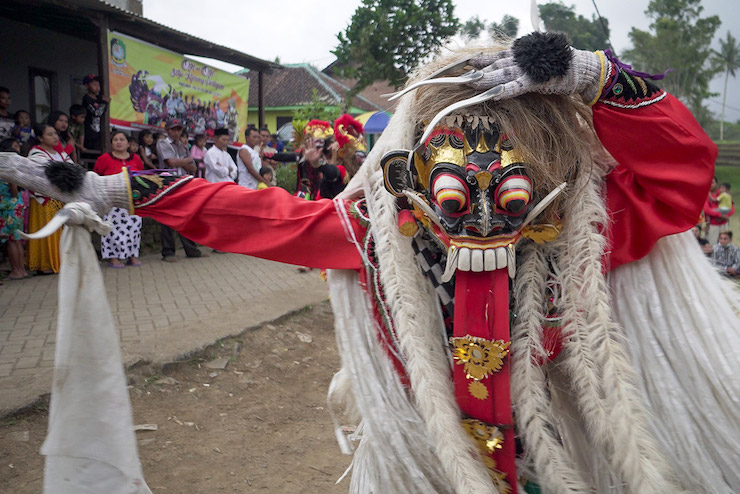
Jaranan In Java | Jay Tindall

Photo © Jay Tindall- All Rights Reserved
I've always been interested in documenting the unusual or lesser known religious traditions (especially those of Asia) whether these were derived from mainstream religions or were stand-alone. It was this interest that guided me to photograph a number of such traditions, including Vietnam's Đạo Mẫu which I documented for two years and produced a photo book of which I'm very proud of.

It's with this frame of mind that I discovered the tradition of Jaranan; an age old Javanese tradition though the photo blog post Exorcism In The Volcano's Shadow by photographer/entrepreneur Jay Tindall.

His blog post describes this tradition as "...an intense ritual of spiritual passion and trance-induced savagery", so I won't duplicate the interesting contents of his post, except to say that Jaranan is a dramatic genre of a horse dance performed in Java.

The most prominent feature of these performances is the trance dancers who establish contact with the spirits of their ancestors. These ancestors -in common with most Asian traditions- have a significant impact on the lives of their descendants, whether in fulfilling wishes or resolving problems and issues.

I have witnessed many of such trances during religious-traditional events, and they all follow a similar pattern. The person in a trance makes him or her totally self absorbed, and grants them a sense of total liberation from their surroundings. 


Jay Tindall also videotaped the scenes at the ceremony (possibly graphic to some) which confirm a similarity to other religious-induced trances that I've witnessed in other parts of Asia. 

Jay Tindall is the co-founder of a travel company, and it is through his work that he investigates Asia’s most interesting destinations. 

Thursday, 16 June 2016

Ulet Ifansasti | City of God

Photo © Ulet Ifansasti -All Rights Reserved
Many in the West have a skewed view of Islam and its 1.4 billion adherents, and much of the fault lies at the door of the mainstream (and other) media that is unwilling or unable to portray a balanced and more nuanced view of this worldwide religion.

Philosophically, I'm against schools that are not secular but in many cases (such as this one) it's poverty - rather than faith- that forces parents to place their children in an Islamic boarding school.

City of God is a photo essay on Lirboyo, an enormous traditional 'pesantren' (Islamic boarding school) in Indonesia. Located in Kediri, East Java, the boarding school is home to roughly 17,000 students, or 'santri'. It was founded in 1910 by KH Abdul Karim. Its pupils and students spend their days reading the Quran, studying Islamic scriptures and learning Arabic. They have around 20 hours of activities daily, beginning at 4am and finishing at midnight.

Ulet Ifansasti is a freelance photojournalist and documentary photographer, with a particular interest in social, environmental and cultural issues. Born in Papua and currently based in Yogyakarta-Indonesia, he started his career at a local magazine in Yogyakarta, Indonesia before joining Getty Images in 2008. 

His work has been published in many leading organizations and publications including GREENPEACE, World Society for the Protection of Animals (WSPA), The New York Times, The International Herald Tribune, STERN, The Guardian, TIME Magazine, USA Today, LIFE, National Geographic Traveller among others.

Tuesday, 29 March 2016

Ta-Tung | Rooe | Storehouse

Photo © Rooe | Courtesy Storehouse

I'm always intrigued by out of the mainstream religious traditions and rites, and was often able to photograph and document them wherever they occurred. This is how I have been working for the past 18 months on my forthcoming photo book Hầu Đồng: The Spirit Mediums of Việt Nam.

Cap Goh Meh is a festival celebrated in Indonesia, Malaysia and Singapore on the fifteenth day of the first month of the lunar calendar. It officially ends the Chinese New Year celebrations. In Singkawang, Kalimantan, Tatung performers - people believed to be possessed by the spirits of ancestors – perform various ancient rituals, during the festival, the performance has similarities with Dayak rituals and is also performed by local Dayaks.

The Dayak are the native people of Borneo, and were feared for their ancient headhunting tradition.

Tatungs are mediums who exercise their craft during the Cap Go Meh ritual to ward off evil spirits, and cleanse the town and temples from evil and bad luck. During the Tatung rituals, participants enter into a trance and perform many bizzare actions, such as stepping on a sword, or piercing steel wires or nails into their cheeks or through their tongues.

The Intermediary is a photo essay by Indonesian photographer Rooe on the Tatungs published on Storehouse.


Sunday, 20 September 2015

Vincent Dirckx | Samburu Warriors

Photo © Vincent Dirckx-All Rights Reserved 

I am featuring two gorgeous portraits of Samburu warriors by Vincent Dirckx, which were made during his recent travels to Northern Kenya. He tells me it took him 48 hours of traveling by an all terrain vehicle over rocky tracks and another trek of 24 hours with a camel caravan and porters to reach this particular tribe. The photographs were made using an off-camera flash and an ND filter, somewhat of a change for Vincent.

The Samburu are a Nilotic people of north-central Kenya that are related to but distinct from the Maasai, and it's based on a gerontocracy style of governance. Gerontocracy is defined as oligarchical rule in which a population or community is ruled by people significantly older than most. Moreover, the Samburu practice polygynous marriage, and a man may have multiple wives. While missionaries have had success in converting more Samburu to predominantly Catholic, and also Protestant forms of Christianity, the majority of Samburu continue to observe their traditional ritual practices.

Vincent Dirckx is a corporate lawyer and a photographer based in Belgium, who started his latter avocation in 2011. His travel photography is multi-faceted and during his many travels, he is eager to photograph the cultures, people, street life, monuments and landscapes that he encounters.

While his work in Northern Kenya amongst the Samburu tribes is his most recent, I encourage you to spend time viewing his other galleries; Omo Valley, Turkey, Japan, the Andes and the Amazon, Indonesia and India. You'll be amply rewarded with some exceptional photography.

Photo © Vincent Dirckx-All Rights Reserved


Monday, 7 September 2015

Juan Pablo Ampudia | Love Me


Here is one of the better multimedia/photographic work I've seen coming out of the Foundry Photojournalism Workshop since its inception, but I'm getting ahead of myself.

Love Me is a multimedia photo documentary on "warias" in Bali, Indonesia by Juan Pablo Ampudia.

In Indonesia, biological men who believe that they are born with the souls of women are known as "warias." The term is a combination of two Indonesian words: "wanita" which means woman and "pria" which means man. As a group, warias are diverse, encompassing what cross-dressers, transsexuals, drag queens, and effeminate gay men would be called in the West.

I'm sure many of my readers would be surprised to learn that transgender people can live openly in Indonesia, a country with the world's largest Muslim population.  That said, Indonesian warias are generally different from transgender women in the United States as an example. For religious reasons, many are not interested in sex-reassignment surgeries and believe that they were born as males, and must return to God when they die.

Photo © Juan Pablo Ampudia-All Rights Reserved
However, living openly does not mean total or even partial acceptance from the community at large. Juan Pablo tells us that the status of transvestites, transsexuals and other transgender persons in Indonesia is complicated. Cross-dressing is not, per se, illegal and some public tolerance is given to some of those working in beauty salons or in the entertainment industry. However, the law does not protect transgender people from discrimination or harassment. Neither does it provide for sex reassignment surgery to those who seek it, nor does it allow transgender persons to gain new legal documents should they opt for the transition. Most discrimination is directed at transgender women, who face challenges with stable employment, prejudice, and housing.

The videos and photographs by Juan Pablo were made in bars in Bali's Seminyak, a mixed tourist  and residential area on the west coast of the island. It's also the centre of life for hordes of the island's expatriates and tourists. The talented characters who work in these bars, seek to show to their country and to the society that they exist, and aided by international tourism, raise awareness among young indonesians about equality and human rights.

Juan Pablo Ampudia is an account director for an advertising agency based in Mexico City, who describes himself as "just a regular guy that uses photography as a tool for self-observation; to achieve my personal human growth."

I think you'll agree he's way more than that.

Tuesday, 1 September 2015

Charles Fourtree | Papua New Guinea

Photo © Charles Fourtree-All Rights Reserved
Papua New Guinea seems to be the end of the earth. It almost is. And it offers intrepid travel photographers some incredible opportunities to document its indigenous culture and traditions.

The Goroka festival is probably the best known tribal gathering and cultural event in Papua New Guinea. It's held every year close to the country's Independence Day on 16 September in the town of Goroka, the capital of the Eastern Highlands Province. About 100 tribes arrive to show their music, dance and culture. This traditional festival is called a sing-sing, and is the biggest of its kind in the world.

Charles Fourtree's gallery of his work in Papua New Guinea allows us to admire his photographs of this event's participants up close and personal. As you will see, feathers of birds of paradise are heavily featured in the festival, either used for decorative head gear or ceremonial dress, and it is often noted how extraordinary that so many feathers can be squeezed on a traditional headdress. The dances and songs during the festival reflect the behavior of the birds of paradise in the wild, which represent beauty and seduction to the tribes.

Charles Fourtree is a travel photographer focussing on portraits and wildlife. He has a special interest in Asia with its great cultural diversity, and he connects with local people in order to see countries through their eyes. 

I gather Charles is currently traveling in the Kutch region of Gujarat. I expect he will return with equally admirable photographs.


Saturday, 7 February 2015

Monique Jaques | Miss Muslimah

Photo © Monique Jaques - All Rights Reserved
To counter the gory headlines of the recent current events in the Middle East, the photo essay on Miss Muslimah may be a relief. It's an award competition that seeks to be the opposite of a beauty pageant, and which took place in Yogakarta, Indonesia in 2014. It's for young Muslim women who are judged to have shown dedication, reputation and concern for Islamic values and community development.

With Indonesia being the world’s most populous Muslim-majority nation, the event is popular and is attracting an increasingly international lineup. Entrants from Trinidad, Nigeria, Iran, Tunisia, the United Kingdom and many Southeast Asian countries take part. 

The hijab is a controversial topic amongst Muslims and non-Muslims alike. While the Qur'an requests Muslim women to dress modestly, it does not specifically institute a dress code. However, most Islamic legal systems define modest dressing as covering everything except the face and hands in public. Wives of the Prophet Muhammad are said to have been hidden behind curtains from the rest of the Muslim congregation because his home was constantly visited by people. Muslim women started then to emulate this tradition by wearing veils and face covers.

For more background information and other images, drop by Al Jazeerah America 's High Heels & Hijabs.

Monique Jaques is a photojournalist based in Istanbul, who spent the past four years focused on documenting issues in the Middle East as well as Afghanistan and India. She graduated from New York University's Photography and Imaging program, and was nominated for the Prix Bayeux- Calvados ‘Young Reporter’ award. Her project ‘Growing Up on The Gaza Strip’, was first published in the New York Times. She was selected as one of the recipients of the PROOF Award for the Emerging Photojournalist for her work in Post-War Libya and featured in the Bursa Photography Festival. She was also featured in the Ian Parry Scholarship show in 2009 and received an Honorable Mention for the 2008 New York Photo Awards. Her work has been published by The New York Times, The International Herald Tribune, The Christian Science Monitor, The Economist, GEO, The Guardian, and CNN, among others.

Saturday, 23 August 2014

Christian Werner | Chained In Paradise


Mental sickness, lack of psychiatric hospitals and traditional healers...all come together in a compelling and disturbing documentary on the mentally sick who are chained, caged or tied up by their families,  on the "paradise" island of Bali.

As is common with other nations of the world, Indonesia is unable to provide adequate mental health facilities to those who are in dire need of them, and it's reported that there are 40,000 Indonesians who are afflicted with mental illnesses, and are treated inhumanly. In Bali alone, it's reported that there are 350 cases who are chained like animals...for fear they will wander off, or that they'll hurt someone or themselves. The Balinese call them "pasung"... or "in chains" and consider them to have been 'punished' by the gods..

With the lack of mental health facilities, families refer those mentally sick to traditional healers; the balians, as they're called, number about 8,000 in Bali. There are about four times as many balians as doctors. The balians are traditional healers who play an important part in Bali’s culture by treating physical and mental illness, removing spells and channeling information from the ancestors.

I photographed balians during one of my photo expeditions in Bali, and found them to be a mix of witch doctors and chiropractors, mixing mumbo-jumbo with massage and manipulation. Most of those I've seen had waiting rooms with many patients.

Chained in Paradise still photographs can be viewed on Christian Werner website.

Christian Werner is a freelance multimedia/photojournalist based in Nordstemmen, Germany. H graduated from the photojournalism & documentary photography course at the University of Applied Sciences in Hannover. His interests are social diversity and global political issues. He worked in various countries in Asia, Africa, Eastern Europe and South America, and he's represented by the agency Laif.

Sunday, 13 July 2014

Chris McGrath | The Vanishing Dokar

Photo © Chris McGrath-All Rights Reserved

What's a "dokar" you ask?

Well, it's a two-wheeled horse-drawn cart found throughout Indonesia, usually decorated with colorful motifs and bells. Its small horses or ponies often have long tassels attached to their bridle. Typical dokars have bench seating on either side, which can comfortably fit three or four persons...and luggage (and huge bags of rice).

Regretfully, the dokars are on their way to extinction due to other more efficient and modern ways of transport. More than 200 dokars were working in Indonesia's Denpasar region, but only a handful remain these days. Denpasar -as in other large cities- experiences an uncontrolled population causing chronic traffic jams that make it difficult for the dokar to work effectively. Cheaper motorcycles have also made the dokar obsolete.

Chris McGrath has documented these last remaining vehicles in his The Vanishing Dokar in lovely monochrome tones, along with copious information about the photographs as captions.

Chris McGrath is an Australian photographer with Getty Images, specializing in editorial and commercial assignments. He has photographed, four Olympic games, the Paralympics, Commonwealth games, the FIFA World Cup, the Rugby World Cup, the MLB World Series, the Super Bowl, the Daytona 500, US Open Golf, numerous US Open and Australian Open Grand Slams, the 2004 Asian Tsunami, the election of Barack Obama and the earthquake and Tsunami in Japan and the London 2012 Olympics.

He has worked for clients such as Nike, NFL, Coca-Cola, the LPGA, NASCAR and the New York Times, and his images appeared in Stern, Newsweek, Time, Sports Illustrated, The Independent, The New York Times, The Los Angeles Times, USA Today, ESPN the magazine, The Guardian, L'Equipe and on daily news and sport websites worldwide.

He currently works in Tokyo, Japan.

Sunday, 15 July 2012

Budi N.D. Dharmawan: Ketoprak (Javanese Theatre)

Photo © Budi N.D. Dharmawan-All Rights Reserved

Ketoprak is a theatrical genre of Java in Indonesia which features actors and performers who sing to the accompaniment of the gamelan. It draws its stories from Javanese history and romances, and in that respect is different from the wayang kulit (shadow puppets) which are based on stories from the Hindu epics.

Ketoprak was created by a Surakarta court official in 1914, evolved into a spoken drama of Javanese and Islamic history but with the modernisation brought along with television and videos, it has lost much of its popularity, and the younger generation has lost interest in traditional folk/cultural arts.

Budi N.D. Dharmawan is is an Indonesian documentary photographer, with interest in social, humanitarian, and cultural issues. His Staged Life gallery documents a ketroprak troupe which he followed.

He describes this experience very eloquently: 

"It is a story of poverty, which is widespread across Indonesia, a country that has been celebrating economic growth in the past decade. It is unimaginable that these people can live on less than USD 10 a month, but yet it is very real. It is a story of people practicing a form of art that younger generation no longer cares about, not necessarily in order to preserve it, but because it is their way to make ends meet. It is a story of life, both on-stage and also off-stage, which somehow feels like it is just another stage to perform."

I haven't attended a ketoprak performance, but i did photograph an Arja performance in Bali. Arja enacts old stories mainly based on the Panji Romances (11-14th centuries) and uses dialogue understood only by Balinese-speaking audiences. Many of the stories derived from Balinese tales, Chinese and Arabic, and from the Mahabharata and Ramayana.

Tuesday, 19 June 2012

Matthew Oldfield: Kecak!

Photo © Matthew Oldfield-All Rights Reserved

"Kecak dance involves a chorus of chanting men dressed in checked cloth, who build a percussive vocal rhythm that has its roots in the Sanghyang trance-inducing exorcism dance."
Matthew Oldfield  tells us he attended a unique Kecak performance in Bali led by Pak Reno who has been developing his own version of the Kecak dance over several decades, and his chorus performs a much looser version of the typical, choreographed story. No two performances are alike and guests are never sure what will happen.

The Kecak music performance is not accompanied by any music instruments, but by a chorus of around 50 to 100 men. Kecak has roots in sanghyang, a trance-inducing exorcism dance.

I've been to Bali a handful of times, and attended Kecak performances in different spots on the island, notably in Ubud and Nusa Dua, however these were performances designed for tourists. The one attended by Matthew seemed to have been non commercial, and only 7 spectators attended it.

Kecak is a form of Balinese dance and music drama, originated in Bali and is performed primarily by men,  A German painter and musician got interested in the ritual while living in Bali in the 1930s and worked to recreate it into a drama, based on the Hindu Ramayana.

Matthew is a freelance photographer based in South East Asia, specialising in editorial and documentary images. He's been involved in both photography and the environment since 1993. He's had articles published in Asian Geographic, Asian Diver, Scuba Diver Australasia, FiNS Magazine and Scuba Globe, and photo credits in a huge variety of publications.
Tom Bourdon, a fellow travel photographer, referred Matthew's work to me and we both agree that these high quality photographs would have been enhanced had it been accompanied by the incredible music and sounds of the Kecak in a simple multimedia photo essay.

Tuesday, 12 June 2012

Stephen Dupont: A Tale of Two Slums

Photo © Stephen Dupont-All Rights Reserved

I really liked these two photographic essays of Polaroids made in the Mumbai slum Dharavi and the Senen slum of Jakarta by Stephen Dupont, an Australian photographer.

Dharavi is one of the world's largest slum and lies on prime real estate in the middle of India's financial capital, Mumbai and has a population estimated to be 1 million. Many businesses flourish in this slum, such as traditional pottery and textiles, a recycling industry, which generate an estimated $650 million turnover a year.

As for the Senen slum, it's a trackside slum in central Jakarta. It's also a center for recycling, and its inhabitants live cheek to jowl with the thundering trains.

Stephen Dupont has produced a photographs of fragile cultures and marginalized peoples, which capture the human dignity of his subjects, and do so with great intimacy and often in some of the world’s most dangerous regions. His work has earned him prestigious prizes, including a Robert Capa Gold Medal citation from the Overseas Press Club of America; a Bayeux War Correspondent’s Prize; and first places in the World Press Photo, Pictures of the Year International, the Australian Walkleys, and Leica/CCP Documentary Award.

His work has been featured in The New Yorker, Aperture, Newsweek, Time, GQ, Esquire, French and German GEO, Le Figaro, Liberation, The Sunday Times Magazine, The Independent, The Guardian, The New York Times Magazine, Stern, The Australian Financial Review Magazine, and Vanity Fair.

He has held major exhibitions in London, Paris, New York, Sydney, Canberra, Tokyo, and Shanghai, and at Perpignan’s Visa Pour L’Image, China’s Ping Yao and Holland’s Noorderlicht festivals.

Friday, 4 November 2011

Andrew Newey: Papua New Guinea

Photo © Andrew Newey-All Rights Reserved

Andrew Newey has been virtually everywhere. He is a documentary travel photographer based in England, and started travelling the world in his early 20′s, and went to college to study the craft, after which he went on a round the world trip to put the theory work into practice. He began his photographic career supplying landscape and travel imagery to the stock photography industry and now focuses on commissions, workshops and personal projects documenting traditional cultures around the world.

He was exhibited at the Royal Geographical Society in London for the 2010 Travellers’ Tales Festival. Some of his clients include Microsoft, Qantas, Bauer Media, Wanderlust, Thai Airways, The Sunday Times, Lonely Planet, P&O Cruises, Rough Guides, AA Media, Imagine Publishing, and Tesco.

Andrew has divided his website portfolio over three main galleries, and the images (although smaller in size than what I love to see) are extraordinarily colorful, and are unadulterated travel photographs. These range from Mongolia to the Mentawai Islands, from Laos to Nepal, from Morocco to Malaysia, from China to India, and from Tibet to Thailand.

Friday, 9 September 2011

Asit: Indonesian Photography

Photo © Asit-All Rights Reserved

Another instance of a talented photographer who neglects to provide full background information on his or her website is Asit. It's a shame because I am certain that photo buyers may want to get in contact with Asit. Having a contact form is insufficient, since a biography provides background information to the buyers and editors. A pseudonym is fine (if warranted) but having no background information signals a disinterest in marketing.

Most of Asit's photographs appear to have been set up very carefully, with meticulous attention and effort given to details, lighting and, in some cases, make up. It's more akin to fashion photography than travel photography.

Photo © Asit-All Rights Reserved

Thursday, 8 September 2011

Francisco de Souza: Travel Photography

Photo © Francisco de Souza-All Rights Reserved

The website of Francisco de Souza is populated with galleries of India, Bangladesh, Nepal, Thailand and Vietnam...large images which grab viewers the way images should. None of this silly small photographs to "protect my work" from Francisco. He wants to show his images, and he does.

His biography tells us he was born and raised in Zimbabwe, where he started to photograph his Shona tribal neighbours since he was eleven. Subsequently displaced from his Zimbabwean home, he travelled to many developing countries in Africa, the Indian Subcontinent, and South East Asia. It is there he started to actively work with and support Non Government Organisations in Indonesia, India and Zimbabwe.

Francisco's work has been shortlisted in the Digital Photographer of the Year competition in 2009, and he received a Diploma in Photography from The Photography Institute of New Zealand in 2010.

In his India gallery, Francisco features an elderly woman in a red sari, possibly a Gujarati or Rajasthani tribal judging from her tattoos, being helped unto the back of a truck...a perfect capture in time and motion.

Thursday, 2 June 2011

Tom Bourdon: Dayakan Dance


Tom Bourdon was recently in Java, Indonesia where he photographed a traditional Dayak dance near Borobodur. He captured the ambient sound with the new and popular Zoom H1, and put together this audio slideshow. You can also view it here.

The Dayak are the native people of Borneo, who live principally in the interior of Borneo, each with its own dialect, customs, laws, territory and culture. Dayaks also live in Indonesia, and have their distinct culture as Tom Bourdon documented.

The Dayak were animist in belief, however many converted to Christianity, and more recently to Islam. Estimates for the Dayak population range from 2 to 4 million.

Tom is a documentary travel photographer specializing in recording cultural festivals & celebrations across the globe. His work has been published in the national & international press as well as guide books & numerous online locations.

I thought I'd add this review of the Zoom H1. It's by B&H, and while it's short and to the point, it gives a reasonable appraisal of the device.

Friday, 29 April 2011

Diego Verges: Ludruk

Photo © Diego Verges-All Rights Reserved
Ludruk is a theatrical genres of East Java in Indonesia. It's a form of traditional performance presented by a troupe of actors on a stage, re-telling the life stories of everyday people and their struggles. Most of the characters were performed by male actors who take the roles of women, but more recently, the sketches and farces feature mostly contemporary domestic stories, and have become commercial entertainment popular with urban and rural working-class audiences.

Diego Verges (featured many times of The Travel photographer blog and one of its Favorite 2011 Photographers) has produced a comprehensive photo essay on the Ludruk, with black & white (and color) facial portraits, and as well as environmental portraits and scenes of these performers.

Ludruk is a must-see for my readers as it merges portraiture, documentary and travel-ethnography photography, and also visually documents an art for that could well vanish in the years to come.

Note: I encountered a similar kind of performance in Bali where it's called Arja. This type of performance enacts old stories in a farcical manner and uses dialogue understood only by Balinese-speaking audiences.

Thursday, 16 December 2010

Vincent Prévost: West Papua

Photo © Vincent Prévost-All Rights Reserved
 I occasionally receive emails from photographers such as the one from Vincent Prévost that make the work of maintaining The Travel Photographer blog feel really worthwhile.

Vincent tells me he's been a regular reader of The Travel Photographer blog for about 2 years, and that it has been a source of inspiration to him. He cites my two posts on Grenville Charles and Diego Verges, who documented tribes of West Papua,  as triggering his own photo expedition "Highlands Encounters" to this remote part of the world.

That's what this blog is all about...to inspire photographers to explore other unfamiliar areas, to try new techniques and to document endangered cultures.

He has been teaching French in South Korea since 2002 and is also a freelance editorial photographer who fuses fine art and journalism. While most of his work is in color, he also enjoys black & white photography, and travels with compact audio equipment to add a further dimension to his visual work.

West Papua is an Indonesian province that borders the independent nation of Papua New Guinea and forms the western half of the world's second largest island. The indigenous people of West Papua are of the same ethnic origin as those in the eastern half of the island of New Guinea. Ethnically and culturally, they are also related to other Melanesian peoples of the Pacific.

Wednesday, 8 December 2010

James Morgan: People of the Coral Triangle


James Morgan features the People of the Coral Triangle, a well made documentary on the Bajau Laut, on his website, along with other multimedia projects such as the Eagle Hunters (previously featured on TTP), and fast-paced documentaries of Hong Kong, Beijing and Tokyo.

As he explains, the Coral Triangle refers to a triangular shaped area of the tropical marine waters of Indonesia, Malaysia, Papua New Guinea, Philippines, Solomon Islands and Timor-Leste. It is there that 3,000 species of fish live, including the largest fish - the whale shark, and the coelacanth. It also provides habitat to six out of the world’s of seven marine turtle species.

The Bajau Laut are an indigenous ethnic group of the southern Philippines, who have migrated to neighboring Malaysia over the course of the past 50 years. They depend directly in the natural resources of the Coral Triangle, and are the last nomadic marine communities of the world. Mostly Muslims, some also worship local sea spirits.

Saturday, 20 November 2010

The Big Picture: National Geo Contest 2010

Photo © Ario Wibisono-All Rights Reserved
The Boston Globe's photo blog The Big Picture is showing off some of the submissions to The National Geographic annual  photo contest. The deadline for the submissions is November 30. The Big Picture editor chose 47 images from the three categories of People, Places and Nature.

No one asked me for my opinion, but I'll give it anyway. My favorite of those shown is the one of the two Indonesian boys playing with roosters in the village of Suradita, near Serpong in West Java. The photographer is Ario Wibisono who's based in Jakarta.

Ario's caption informs us that this was not a real cockfight. I'm confused by their dress as I took them to be Balinese children, but they're not...they're Javanese.

I also liked another one (#5) also by Ario Wibisono of the musician in Tenganan Village in Bali, playing the bamboo flute to a disabled child. I spent a couple of hours with this man during my Bali: Island of Odalan Photo~Expedition ™, photographing him playing his various instruments (including a sort of didgeridoo) and recording some of the pieces he played.

THE FEAST OF SAN GENNARO 2026

  The Feast of San Gennaro, also known as San Gennaro Festival, is a Neapolitan and Italian-American patronal festival dedicated to Saint Ja...