Showing posts with label Kashmir Photo Tours. Show all posts

Saturday, 8 June 2013

Back Story | The Sufi Poet(ess) of Hazratbal

Photo © Tewfic El-Sawy-All Rights Reserved

"I Knew You Would Come"
At the Hazratbal shrine in Srinagar during my just completed Sufi Saints of Rajasthan & Kashmir Photo Expedition-Workshop , we came across a middle-aged woman devotee, clutching a well-thumbed Qur'an, praying and meditating in solitude. Her prayers became more audible as I approached her, and she seemed oblivious to being photographed. Her face was streaked with tears, as she was totally immersed in her devotion.

The Hazratbal shrine and mosque is on the western side of the Dal Lake, and is an important place of worship for Muslims. This shrine blends Mughal and Kashmiri architectural styles and dates back to the 17th century. It contains a relic, the Moi-e-Muqqadas, believed by many Muslims of Kashmir to be a hair of the Prophet Muhammad. This relic is shown to the general public on very special occasions, such as the recent observance of the Isra and Mi'raj; the ascension of Prophet Mohammed to Heaven.

Through our guide and interpreter, Nizar Malik, we learned she had traveled quite a distance from her village to pray at the shrine, and that she had been foretold of meeting us in a dream.

Unprompted, she launched into a plaintive and devotional song in Kashmiri...which, to my ears, sounds very similar to Turkish, sprinkled with some Portugese. In reality, Kashmiri has thousands of words Persian and Arabic due to the arrival of Islam in the region, however, it remains basically an Indo-Aryan language.

For more of my monochrome photographs from Srinagar, see Kashmir's Sufi Soul.

I was told her song is a devotional poem to the Prophet Muhammad, and how his light shone over El-Tor in Sinai, where Moses received the tablets from God.


Thursday, 6 June 2013

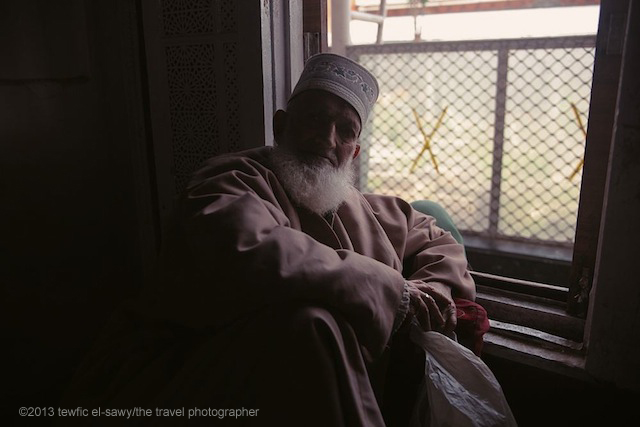
Aziz Ahmed, The Srinagar Unani Hakim

"Arak Kelab". Photo © Tewfic El-Sawy-All Rights Reserved
"Aziz Ahmed, The Unani". Photo © Tewfic El-Sawy-All Rights Reserved
"Dame-Jeanne Bottles". Photo © Tewfic El-Sawy-All Rights Reserved
"Aziz Ahmed, The Unani". Photo © Tewfic El-Sawy-All Rights Reserved
Across from the Sheikh Hamdan mosque in Srinagar, I noticed a small traditional store (top photo) with a sign in Urdu script which, in Arabic, read "Dogs' Sweat"! However, on further clarification, it was a store owned by a vendor of rose essence, and the sign actually meant "Sap of Roses"....quite a bit of difference.

I entered the dingy small store, and introduced myself to the owner Aziz Ahmed, a Kashmiri unani who's been practicing this dying profession since inheriting the business from his father, and his grandfather before him. The store had been standing for many generations, and still has a wonderful array of antique bottles and jars; some of glass, others in ceramic, imported from England during the Raj. Some larger ones called dame-jeanne (or demi-john in English) have capacities of up to 15 gallons. I know that because my maternal grandmother used to buy similar bottles in Cairo, and convert them into beautiful floor lamps for her home.

But what is unani? It's a form of traditional medicine practiced by Muslimsand first arrived in India around 12th or 13th century with the establishment of Delhi Sultanate and Islamic rule over North India, and subsequently flourished under the Mughal Empire.  Unani is the Arabic word for Greek, and it's based on the teachings of Hippocrates, hence the term.

However, Aziz hasn't really practiced it for a while, and it's a profession that is slowly but surely disappearing. He survives by selling rose water used to wash the Sufi shrines, and kewra water used for flavoring various foods, sweets syrups and soft drinks. Extracts of these two florals are also used for perfume...so the unani may have turned into a attar (a perfume seller).

Listen to Aziz Ahmed telling me (in accented English) about the demise of his business:


Tuesday, 28 May 2013

Sufi Saints Photo Workshop: The Verdict

Photo © Tewfic El-Sawy-All Rights Reserved
"Toto, I've a feeling we're not in Kansas anymore."
That was the line that came to my mind the most frequently during my two weeks Sufi Saints of Rajasthan & Kashmir Photo Expedition-Workshop...and I had to remind some of the group members of it as well.

In comparison to the 10 days or so spent in Ajmer attending the death commemoration of the Sufi Saint Moin'Uddin Chisti (aka Nawaz Gharib), the initial days of the workshop were spent in Srinagar; the capital of Kashmir, and the experience was virtually placid. The group interacted with and photographed people of all walks of life during the walk-abouts the streets and alleys of the city, during the visits to the shrines and mosques, and with about everyone...from the shikara boatsmen to the flower vendors and even the elderly religious clerics who wanted to salvage our souls. I can confirm that the Kashmiri people are amongst the nicest and most hospitable people I've ever met...and if you haven't been already, just go. 

Seven of the group stayed in the stellar luxury of the Sukhoon houseboat (a truly magnificent houseboat which only had 5 bedrooms), while I and another group member stayed in another nearby houseboat...far from having the same quality of accommodation as the brand new sleek Sukhoon. I imagine Onassis' yachts would be of the same luxurious standard.

Traveling on Indian Railways from Delhi to Ajmer was a cinch, and was a pleasant experience...albeit one that took 6 hours to complete. I was looking forward to settle in the luxurious setting of the Ananta Resort near Ajmer, but was shocked to find it didn't have rooms for us because it had accepted the booking of an Indian wedding with literally hundreds of guests, and we had been moved to the Pushkar Resorts...an oasis of calm within 15 minuted drive. Having vented my spleen with the choicest of epithets directed at the Ananta management, I bowed to the inevitable and we moved to the Pushkar Resorts (in retrospect, a much better choice) for a few days until the wedding ended. We did get complimentary meals as compensation, which soothed our feelings a little. In case you seek hotel accommodations near Pushkar, do not go to the Ananta...it's more of a convention center and principally caters to noisy Indian weddings. 

As for the photographic experience during the Urs (Moin'Uddin's commemoration), it was mixed. Mixed not because of the lack of incredible subjects, but because of there being too many, and after a day or two, our eyes got used to them...and we became blase. We became understandably more choosy in what and who we photographed, and the buzz and the novelty decreased. That is the main difficulty in attending and photographing such events...after a while, it becomes repetitive and it becomes a struggle to find "new" angles.

The first few days at the Urs were enjoyable and full of  photo opportunities that most of hadn't ever seen.  The fakirs and the Sufi ascetics (the real and fake), the charlatans, the flag-waving pankiwallahs,  some maimed and others healthy...the vagabond self mutilating malangs, the venal khadims squeezing every paisa from the poor and gullible, the eye-popping rituals...some based on Hinduism, Buddhism and even on paganism,  the disturbing self-induced trances by mostly schizophrenic women and their attempts to exorcise jinns, the disparity between Sunni and Shi'a Islamic traditions, the welcoming kindness of pilgrims towards foreign visitors, and our being interviewed on Indian national television all made for exhilarating initial days.

I was thrilled my choice of Tahoor Chisti ( a khadim and descendant of the Saint) as a facilitator for the event proved to be extraordinarily fortuitous. He was instrumental in procuring camera permits for us, got us replacements when we need them...and was the go-to-man whenever we needed to. A dignified and an extremely affable and helpful young man...and certainly an asset to our photo workshop. Shuchi Kapoor, a freelance photographer and writer, who joined the workshop in Ajmer as my assistant, is also to be commended for her help and skills.

One of the highlights of the Urs was having our very own guelaf (a large velvet sheet embroidered with verses from the Qur'an) which we placed on the saint's marble tomb, along with a basket of sweet-scented roses. Doing so exposed us to the most chaotic part of the event since we shared the tight space with hundreds of other pilgrims/supplicants; some of whom gripped with a religious frenzy.

I'd be remiss if I didn't mention the failed attempt of my being being pick-pocketed. Surrounded by a mass of pilgrims, and sensing my iPhone had been lifted from my pocket,   I grabbed the nearest man next to me...shook him out of his wits and yelled "thief" at the top of my lungs.  A policeman swiftly grabbed the fellow and as if by magic, my iPhone was returned by some other guy claiming it had fallen from my pocket! Another highlight was to meet a bunch of transgendered hijras in their rooms overlooking the main street in Ajmer.

What would I do if I had to repeat the workshop? Well, I'd extend the Srinagar part of it for a couple of days  and attend the first half of the Urs...and skip its latter part with its claustrophobic-inducing crowds.              

Tuesday, 7 May 2013

Sufi Saints Photo Workshop | Srinagar

Photo © Tewfic El-Sawy- All Rights Reserved
Srinagar is different from anywhere I've been to in India. Whilst there's Indian army presence in some of the streets, we haven't experienced any road blocks or inconveniences. The food is just spectacular (I had some of the best lamb kebab for lunch today...even better than Karim's in Delhi!), and while I would have preferred warmer nights, the days have been comfortable.

I think the standout event today occurred when we went to the Hazratbal Shrine in the morning, and came across a praying woman in this holy site, who was sobbing silently in a corner of the mosque. Eventually, she beckoned me over and was surrounded by the members of our group including Nizar, our Srinagar guide. It transpired that Misra had come to the sacred shrine from her home 60 kilometers away just to pray, clutching her tattered Qur'an, and pleased to have met us. She recited and sang a soft and delicate poem in her native Kashmiri who sounded to me like Turkish.

We also spent quite a while at the shrine of Sheikh Hamza Makhdum, or Makhdoom Sahib, Mehboob-ul-Alam and Sultan-Ul-Arifeen. It is one of the most sacred shrines in Kashmir. (Above photograph)

Photo © Tewfic El-Sawy- All Rights Reserved
  We ended the day at the Khanqah mosque, known as the Shah Hamdan Masjid, near the river Jhelum. It was built in 1395 by Shah Sikandar to commemorate the visit of Mir Sayyid Ali Hamdani, better known as Shah Hamdan. Fire claimed the mosque several times in the following centuries and the current structure, as seen today (except for the more recent cloisters), was sponsored by Abul Barkat Khan in 1732.

Friday, 12 April 2013

The Sufi Saints of Rajasthan & Kashmir Photo Expedition-Workshop

On the cusp of departure!

All arrangements completed...accommodations set up...fixers lined up...background presentation on Sufism is prepared, and naturally The Travel Photographer's trademark multimedia workshop slideshows are fired up.

Nine photographers...with their photographic and audio gear will soon descend on Srinagar for 4-5 days of intense documentary work in this unique Kashmiri capital known as being the land of Sufis Saints. It is claimed that Hindu thought and religion greatly influenced Kashmiri sufis, and formed its syncretic essence.

Nine photographers...along with their cameras and audio recorders will travel from Srinagar to Ajmer; the holiest of cities for Sufis and others, and where the shrine of the Sufi saint Khwaja Moinuddin Chisti, equally revered by Hindus and Muslims, will witness the commemoration of the death anniversary of the saint in unparalleled manifestations of Sufi fervor and devotion.

This is the largest commemoration of Sufi saints in India, attended by many thousands of South Asian Muslims.

I may be mistaken, but this is the first and only photo expedition-workshop whose objective is to record the commemoration of the death anniversary Sufi saint Khwaja Moinuddin Chisti.

A few days in Delhi will precede the photo expedition-workshop, and I look forward to re-acquaint myself with one of my favorite cities. Plans are afoot to keep me occupied and busy....and I hope to have the time to re-sample the Lucknow specialty of tunde ke kabab in Nizzam Uddin and Karim's seekh kebab!

Saturday, 16 March 2013

Dal Lake | Panidhar Revanur


I'm pleased to feature Venice of Asia (Dal Lake); a lovely video by Panidhar Revanur of the famous Dal Lake in Srinagar. The post is timed to show the beauty of the lake to the participants in my forthcoming Sufi Saints of Rajasthan & Kashmir Photo Expedition-Workshop.

According to Wikipedia, ancient history records mention a village named Isabar to the east of Dal Lake as the residence of goddess Durga. During the Mughal period, the rulers of India designated Kashmir, and Srinagar in particular, as their summer resort. The area around Dal lake in Srinagar was developed with Mughal-type gardens and pavilions.

Interestingly, during the British Raj though the Maharaja of Kashmir restricted house building in the valley, the British circumvented this rule by commissioning lavish houseboats to be built on the Dal Lake. The houseboats are generally made from local cedar-wood and measure 24–38 metres (79–125 ft) in length and 3–6 metres (9.8–20 ft) in width, and are graded in a similar fashion to hotels according to level of comfort.

Panidhar Revanur is based in Bangalore, and used a Canon 5D Mark II with Magic Lantern 17-40mm,  24-105mm, a Glidecam HD 4000, and graduated filters.

I'm not sure why the opening soundtrack is an Arabic song, especially as there is wonderful Kashmiri music which would have furthered the authenticity of the piece.

Thursday, 14 February 2013

How Hwee Young | Mongolian Shamans

Photo © How Hwee Young-All Rights Reserved
Shamans are people (they can be of either gender) who are considered to have access to the world of benevolent and malevolent spirits. Shamans typically enter into trances during their ritual, and practice divination and healing.

My experience with a shaman was in Bhutan...not far from Paro, where he was holding a ritual to cleanse a child from evil spirits. The ritual took place in a very modest farmhouse...in its main room with the family and neighbors attending. The process involved the shaman to eventually "host" the spirit in his body whilst in a trance, then running out of the house to expel it. 

So I am glad to feature Mongolia Shaman Brothers; a photo essay by the talented How Wee Young. 

Mongolian shamanism is an all-encompassing system of belief that includes medicine, religion, a cult of nature, and a cult of ancestor worship. Male shamans in Mongolia are called boo (isn't that funny?), and they consider themselves to be an intermediaries between the visible world and the hidden world of spirits and gods.

In Mongolia, shamanism merged with local Buddhist traditions, and it’s often impossible to tell where one ends and the other begins.

How Hwee Young is a staff photographer with the european pressphoto agency b.v. (epa) based in Beijing, China. Her career began in 2001 where she joined Singapore's leading newspaper The Straits Times as a photojournalist. Over the last ten years, her images have been published on front covers and featured in major newspapers and magazines including the NewYork Times, British Times, the International Herald Tribune, the LA Times, the Sydney Herald, the Telegraph, Time magazine, Der Spiegel, GEO Magazine, South China Morning Post, Bangkok Post, amongst others.

Friday, 23 November 2012

New! Unique! The Sufi Saints Of Rajasthan & Kashmir


I earned the reputation of planning, organizing and leading unusual "off the beaten path" photographic experiences, so I am particularly pleased to announce my forthcoming The Sufi Saints of Rajasthan & Kashmir Photo Expedition-Workshop in early May 2013, which promises to be another unique photographic expedition, rivaling in intensity those that preceded it.

This is a unique photo expedition delving into the esoteric traditions of Sufism in Srinagar (Kashmir) as well as to attend the Urs Ajmer Sharif, an annual commemoration of Sufi saints in Ajmer (Rajasthan). It is the largest commemoration of Sufi saints in India, attended by many thousands of South Asian Muslims. The Ajmer event attracts the pious and the not-so-pious...the religious and the charlatans, the fakirs and the storytellers.

In common with my photo expeditions-workshops, the aim of this one is to assist participants produce multimedia bodies of work by merging their still photography and audio recordings to create compelling narratives.

For a taste of my work with Indian Sufism, interested readers can view The Possessed of Mira Datar, an article and photos that offer insight into sufism in the subcontinent, the multimedia photo essay on The Possessed of Hazrat Mira Datar, and a gallery of still photographs on In Search of the Sufis of Gujarat.

Details are on The Sufi Saints of Rajasthan & Kashmir Photo Expedition-Workshop website.


Sunday, 18 November 2012

The Travel Photographer's Sufi Saints Expedition-Workshop


I know...the wait is excruciating...but it'll be worth it. It's only a matter of days and details will be announced to my newsletter subscribers and on this blog.

This, as with my previous photo expeditions-workshops, is photo-journalism and travel-documentary oriented, will largely focus on story-telling, and on how to produce audio slideshows rivaling in quality and content more elaborate multimedia productions.

In the meantime, click the image for a larger poster image. I think it's really cool.

PS. I just realized that the last 3 posts are titled 'The Travel Photographer's...'. Self-centered or building anticipation?

Sunday, 6 February 2011

Rabari Dancing "Girls" (or Gopis)

Photo © Tewfic-El-Sawy-All Rights Reserved
This is my first post since arriving in India on January 27 to lead my In Search of Sufis of Gujarat Photo-Expedition. As my internet connection is somewhat tenuous (even though we're staying at the sumptuous Imperial Palace in Rajkot), this post will be brief. The photo-expedition has progressed quite smoothly in the quest of Sufi centers in the southern part of the Gujarati peninsula. We were welcomed, and treated with the utmost courtesy by the guardians of the various shrines we visited; some were very popular with devotees whilst others were almost deserted...but more will be explained when I do my end of photo expedition verdict in a couple of weeks.

In the meantime, the above photograph is of a small group of Rabari women whom we chanced on on the road to Junagadh. They belong to small sect of Rabari pastorals who believe they are descended from Krishna's dancing girls known as gopis. On their way to a temple (or mandir), they performed one of their dances for our lenses. I have many more of these, but I'm pressed for time so this will do for now.

We are on our way to the tribal lands of Gujarat, and we should be in Bhuj tomorrow for the start of the Kacchh section of the photo-expedition.

Monday, 27 September 2010

Kashmir: Will 2011 Be It ???

Photo © Altaf Qadri/ AP Courtesy SacBee's The Frame-All Rights Reserved

 I read with interest that the Indian government announced it would start releasing jailed protesters, ease security in Kashmiri towns and cities, reopen schools and universities, and offering financial compensation to the families of those killed since the protests in June.

I've been keen to go to Kashmir for a number of years, but was stymied by political unrest in the region, by conflicting time constraints and other destinations. I certainly kick myself for not taking the opportunity of being in Manali with the Foundry Photojournalism Workshop in 2009, and travel to Srinagar as some in the workshop did.

So the possibility of a solo-trip (or even a group photo-expedition) to Kashmir is once again rearing its head because of this announcement...only time will tell if the Indian government is serious with this new policy, or whether it's just a public relations stunt before the Commonwealth Games in Delhi.

I'm eager to photograph in Kashmir...and its rich and unique Islamic traditions. In all my years of traveling in India, I have not made it yet. Something tells me that 2011 will be it... Inch' Allah.

Wednesday, 17 March 2010

Live From Oaxaca


Photo © Tewfic El-Sawy -All Rights Reserved

After suffering the trauma of temporarily losing my checked-in luggage between Newark, Mexico City and Oaxaca, I was delighted to be reunited with my belongings a mere 4 hours later. Not too bad Mexicana Click!! Of course, I jumped the gun and bought toothpaste/toothbrush and some other essentials (even a t-shirt) just in case, but that story ended well.

So here I am typing/blogging away in the patio of the delightful Hotel Aitana in the Centro Historico de Oaxaca, after a morning replete with photo ops in the two main markets of the town. We were glad to photograph a Guelaguetza rehearsal of young boys and girls at the Zocalo, who were prepping for a main event next Saturday.

We are waiting for one more member to join our group this afternoon, and we will then start the afternoon session. In the meantime, here's an image of a Oaxacan laborer. I can't tell if it sharp, or well processed as I'm using my Acer netbook...but it'll do for now.

Friday, 13 November 2009

Kirsten Luce: Kashmiri Family Portrait


Here's a new portfolio by the talented Kirsten Luce titled A Kashmiri Family Portrait; a family living with the ghosts of their loved ones.

Kirsten is a freelance photojournalist working in New York City. Her work was published in The Washington Post, Los Angeles Time, the Atlanta Journal-Constitution, Houston Chronicle, Miami Herald (International Edition), AP, Bloomberg News and CARE International.

Apart from gleaning various awards, she was a key staff member of the Foundry Photojournalism Workshop in Manali last summer, which is when she continued on to Srinagar to produce these soulful and sensitive Kashmiri images. Many of those images are beautiful with lovely light, but my favorite image is that of the young girl combing her hair.

An interview with Kirsten was published on TTP here.

Friday, 22 August 2008

Kashmir Rumbles

Farooq Khan/European Pressphoto Agency-All Rights Reserved

The New York Times features an article today on the current civil unrest in Kashmir, where it seems that the bitter dispute between India and Pakistan has reappeared. It all started with a dispute over a 99-acre piece of land, which has for more than two months been encouraged by both separatist leaders in Muslim-majority Kashmir and Hindu nationalists elsewhere in India.

It is sad that this festering wound has not healed. During the first few months of the year, tourists were flocking to Dal Lake in Kashmir. Eric Beecroft and I were so encouraged by the improving political and civil situation that we announced a wonderful Kashmir: Paradise On Earth Photo Workshop.

In late April, we decided to postpone it following explosions in Srinagar's main markets, and at the advice of our fixers and agents who believed the situation would get worse. Nevertheless, both Eric and I still hope that calm will prevail, and an accommodation will be sought and achieved between the two sides of the conflict allowing us to schedule the same workshop next year.

Thursday, 10 January 2008

Benoît Marquet: Fishermen of Kashmir

Image © Benoît Marquet-All Rights Reserved

Benoît Marquet is an independent photographer based in New Delhi, who specializes in news and documentary photographic assignments from South Asia.

He has worked in Kashmir, and his website showcases a photo essay (Kashmiri Fisherman) on the fishermen who ply their trade on Dal Lake. The life of a Kashmiri fisherman is no different from other fishermen all over the world. Waking up before dawn to fish and returning home just after sunrise, the Kashmiri fishermen have a difficult time making ends meet. It's probably a dying profession, with his children working in other occupations.

Srinagar is said to have been founded by the Buddhist Emperor Ashoka during the third century B.C. Dal Lake, the Jhelum River, and a looping canal that joins the two effectively make an island of Srinagar's busiest section.

Dal Lake is surrounded on three sides by mountains, and it is the home to houseboats and gondola-like shikaras. These provide transportation the lake and its floating gardens. It's estimated that there are 602 houseboats on Dal Lake, supporting a population of nearly 60,000 people. An interesting factoid about the houseboats: During the Raj, the ruler of Kashmir did not allow the British to build homes on Kashmiri territory, so to circumvent the law, they built houseboats.

Tuesday, 18 December 2007

Kashmir: Photo Expedition & Workshop


I'm pleased to announce that a photo expedition-workshop in Kashmir (India) is planned for July 27-August 9, 2008. The Kashmir: Paradise On Earth photo workshop-expedition is set in this beautiful mountainous area of India, set deep within the Himalayan mountains on its frontier with Pakistan, China and Tibet.

The floating city of Srinagar is the workshop-expedition's base, and the initial days in India will be spent photographing Delhi's Islamic character.

This workshop-expedition will involve extensive fieldwork shooting stories in Delhi and Srinagar (and beyond), one on one portfolio reviews, nightly slideshows, panel discussions, and working dinners.

Eric Beecroft and Tewfic El-Sawy are leading the Kashmir: Paradise On Earth photo workshop-expedition. Both have extensive experience in leading workshops and photo expeditions to India, South East Asia and elsewhere. The workshop is supported by Soundslides, and other corporate support is currently being arranged.

To log on to the photo workshop-expedition website for further details, go to:

Kashmir: Paradise On Earth

A DAY OF PRIDE | 2026

  I attended Pride Day at Washington Square Park on June 28, 2026, using my cameras mostly shooting from the hip, and pressing the shutter w...