Showing posts with label Shanghai. Show all posts

Sunday, 4 October 2020

Sung Kwan Ma | Hanoi Portraits

Photo © Sung Kwan Ma | All Rights Reserved

It's always a genuine pleasure to view the work of a photographer who shares many of one's own aesthetic, as well as geographic affinities. Through a mutual Facebook contact, I discovered the lovely work of Sung Kwan Ma, a photographer born in Seoul and now based in New York City. He has a number of galleries on his website, that include work from various cities in India, China, Thailand, Cambodia, Sri Lanka, Myanmar and Viet Nam. His work includes portraits and street photography, as well as wedding photography...both in color and monochrome.

It's his Viet Nam photographs that I loved the most, especially those of his street portrait sessions of Thu Thuy, a Hanoi-based model. He has chosen to photograph her amongst the bustle of the old quarter in Hanoi, known as Pho Co; one of my favorite areas for street photography because of its ambiance and exotic back walls that are often inscribed with mobile telephone numbers as adverts...and where the beauty of the Vietnamese model in her traditional red and white ao dai is amply displayed.

Interestingly, he has also used the widescreen 16:9 aspect ratio in his framing for a selection of his portraiture work, such as in Shanghai and in NYC. He preceded me in that style, as I am preparing to do the same in a forthcoming project with Lise Liu (see my previous post).

As per his website, Sung's extensive spiritual journeys in India and humanitarian activities throughout Asia over the past two decades have been the soul and defining framework of his work. He specifically mentions his affinity to the various cultural diversities of India and the Indian people. His images seek to capture the emotional depth of traditional sentiments and the joys of festivity.

A photographer to follow.

Tuesday, 28 July 2020

In Praise of the Qi Pao/Cheongsam

Photo © Tewfic El-Sawy | Shanghai
I fault Maggie Cheung in Wong Kar-Wai's magnificent "In The Mood For Love" movie for my qi pao/cheongsam fascination, which birthed my interest in producing 'photo films' featuring friends and/or semi-professional models wearing these quintessential Chinese dresses. While I'm also interested in Chinese opera costumes and to a certain extent, 'hanfu' (meaning clothes of the Han people) dress, it's the qi pao/cheongsam that is top of the list.

However, it's really my interest in Shanghai of the 1920-1930s historical era that introduced me to the dress.

The qi pao (旗袍) is pronounced as chi pao in Mandarin Chinese, but due to Hong Kong's influence, most of us call it cheongsam. The dress was popularized during the Qing dynasty (1644–1912). The word "qi pao" means "banner dress", a sort of baggy robe similar to the French robe-sac fashion of the 1960s. 

It was a long one-piece loose fitting meant to cover the whole body from neck to feet, and was only worn by the Manchu class. It was meant to be 
very conservative and unrevealing, and was only after 1900 that the Han Chinese adopted the style, but in so doing made some modifications to the original design.

When Shanghai -competing with Paris- became the epicenter of high fashion and the Chinese capital of haute couture in the 1920s, the qi pao shed its conservative ancestry, and became de rigueur for the fashionistas of the time.

Photo © Tewfic El-Sawy | Shanghai
I read there are actually two main traditional qi pao styles. Northern China favors the Beijing style which is called "Jing pai", and is more angular with a more conservative full-length loose form. The south prefers the Shanghai style called "hai pai", which is more form hugging and can be of various lengths. 

The modern qi pao has a zipper stitched into the side and a fake fastening on the front. Traditionally, the front was fastened by pankou (button) knots, but these are now only used for decoration. I've seen some that still have the original pankou knots though.

In the view of couturiers, the qi pao is a garment that embodies traditional Chinese etiquette and culture. With collars that stick upwards rather than folding, the qi pao causes the wearers to raise their heads and push out their chests. It also discourages glancing right and left. This explains Maggie Cheung's famous scene in which she walked up the staircase without looking at Tony Leung!

Saturday, 11 July 2020

The Qi Pao, Pill Box Hats & Shanghai Fashion 1930s

Photo © Tewfic El-Sawy | All Rights Reserved
One of my photographic interests is visual stories "photo-films" (see an example The Girl of Nanjing) that endeavor to recreate Shanghai in the 1930s by using fashion elements popular during its heyday era. The most popular fashion statement of the time was the qi pao (aka the cheongsam in Cantonese) which evolved to its present form over the years of the Qing Dynasty (1644-1922).

During that dynastic period, women of Han descent wore two piece outfits while the Manchu women wore a long robe. With the advent of unity in China, women all over the country began to wear the qipaoEarly on in the 1900s, the qipao was loose-fitting, generally long-sleeved, and worn with unadorned, plain hairstyles. The modern version of the dress, now recognized as the ‘standard’ qipao, was developed in Shanghai in the 1920s, and became more form-fitting and with a high cut, and frequently worn with hairdos known as "finger waves".

Photo © Tewfic El-Sawy | All Rights Reserved
Evolving from its original appearance as a plain and sober Chinese robe to a more exciting style, the qi pao eschewed more traditional silks embellished with embroidery for cheaper contemporary textiles, with a greater variety of designs such as florals, dragons and geometrical patterns.

Society women in China knew that wearing their qi pao with its high collar, side slits and hour-glass body-conscious shape was being equated with an Eastern mystique. They added fur stole in winters, and pill box hats with veils to add more mystery to their appearance. The latter were invented by milliners and hat-makers in the 1930s, and were hugely popular for their simplicity and elegance. 

During the Chinese Cultural Revolution (1966–1976), the qi pao was seen as a feudal dress of the ancient times, and abandoned as daily clothing. However, in 1984, the qi pao/cheongsam was specified as the formal attire of female diplomatic agents by the People's Republic of China.

Uncredited Photo. Source Pinterest

Monday, 20 April 2020

POV | Example -The Usefulness of Mood Boards

Photo © Tewfic El-Sawy | All Rights Reserved

In my previous post, I wrote about the usefulness of mood boards; especially when discussing with the models/friends the concepts for the photo sessions, and how they help me overcome any language difficulties -if any- with the photo shoot team.

I thought I'd illustrate this usefulness with an actual example from a photo session in Shanghai a year ago...by posting one of my photographs (top) of Ms. Tian Yi Yi alongside another photograph I had found on Pinterest that I liked and added to my mood board.

I sent the Pinterest photo to a photographer friend in Shanghai who thought it had been taken at the Shanghai Film Park in Chendun which has sets of urban 1930 Shanghai. His ample "Rolodex" provided Tian Yiyi; a model who fit the persona of Ruan Ling-Yu, the late actress who was to be the subject of my photo-film The Immortal.

The film park opened in 1998, the 400,000-square-meter compound hosted the production of more than 100 films and TV series every year, with titles like "Lust, Caution," "Perhaps Love" and "The Mummy: Tomb of the Dragon Emperor."

When the team and I were there, we walked up to the main square and true enough, the tram on its tracks was waiting. It was most probably the same as in the original photograph, although it actually looked a little less spruced up. 

Tian Yi Yi, all dolled up in her qi pao/cheongsam, pretended to be a passenger alighting from the tram...and as they say, the shot was "in the can".

Saturday, 11 April 2020

My Work | The Wasted Years


wasted years by Tewfic El-Sawy on Exposure                      SCROLL DOWN ON THE IMAGE

The Wasted Years is my latest gallery of Yi Yi's photographs which were made in Shanghai's Guilin Park (桂林公园). I chose a title that reflects our current situation in being locked up (or in isolation) at home during the COVID19 virus (although I certainly hope it won't extend to more than a couple of months and not years), and because I was recently influenced by a Chinese thriller movie named The Wasted Times, starring the gorgeous Zhang Ziyi.

Although the photographs from this photo shoot were not destined for The Wasted Years gallery, I chose a handful of these photographs to illustrate a fictitious Shanghai gangster moll, a long-suffering but loyal girlfriend of a ruthless triad boss, wasting her youth and beauty in Shanghai between 1934 and the end of the war in 1945. It helped that 
Yiyi had been very quick to "adapt" to the feel of this Shanghai era, and had all the accessories needed to play the part; the opium pipe, the fake fur stole, the yellow fan and the high heels.

To give the photographs a semblance of authenticity, I used a combination of filters in ON1 2020 to achieve the "old" look preset.

Wednesday, 1 January 2020

New Website | New Galleries


To start 2020, I put together a freshly baked website using my domain name of thetravelphotographer.net. I've used the services of Wix.com based on my previous experience with it, and because of the diversity of its templates. 

The website is dedicated to my photographic work of China which include recent projects which, for now, consist of Chinoiseries and Chinese Opera. While the latter is self-explanatory, Chinoiserie is defined as a "style of ornamentation current chiefly in the 18th century in Europe, characterized by intricate patterns and an extensive use of motifs identified as Chinese". I used the term to showcase my fashion-historical storytelling work involving cheongsam or qi pao clad models. The overriding theme in the Chinoiserie gallery is that of a "Shanghai-1930" atmosphere which I seek to recreate.

Each photograph in the Chinoiseries section carries the title of a fashion-historical story; some of which are 'photo-films' and are found on my other website https://thetravelphotographer.exposure.co/ and on my Vimeo site.  The website also features a number of Chinese opera related galleries and street photography in Hong Kong, Taipei, Tokyo and naturally New York City.

Tuesday, 31 December 2019

La Dame de Soie | Madame Wellington Koo

I end the year with a wonderful -albeit too short- video entitled La Dame de Soie (or The Lady of Silk) which was produced for Nowness, in collaboration with Cartier. It's directed by Robin & Cako, and stars Li Meng. 

The video (feeding my interest in Chinese culture, aesthetics, historical fashion) is based on the character of Madame Wellington Koo, also known as Oei Hui-lan, a well-known Chinese-Indonesian international socialite and style icon, who from late 1926 until 1927, was the First Lady of the Republic of China. After a failed first marriage, she married the pre-communist Chinese statesman Wellington Koo, and was a daughter and heiress of the colonial Indonesian tycoon Oei Tiong Ham.

Both her parents were from the "establishment". Her father was the descendant of one of the wealthiest families in Java, while her mother came from the aristocracy as a descendant of the highest branch of the traditional Chinese establishment of colonial Indonesia.

Despite her family's great wealth, however, as a Chinese – albeit with Dutch nationality – Hui-lan and her family were treated as second-class citizens by the Dutch administration, and had to carefully navigate their way past the difficulties they often faced in their dealings with government officials.

Oei Hui-lan married Wellington Koo in Brussels in 1921 and lived in Geneva then moved to Beijing where he served as Acting Premier in the evolving republican Chinese state. Between October 1926—June 1927, Wellington Koo also acted as President of the Republic of China for a brief period, making Oei Hui-lan the First Lady of China. The couple then spent time in Shanghai, Paris and London where Oei Hui-lan became a celebrated hostess. In 1941, she moved to New York. She had divorced Wellington Koo in the fifties, and remained single until her death in New York 1992 at the age of ninety-three. (Source: Neehao.Co.UK)

She is remembered for writing two autobiographies and for her contributions to fashion, especially her adaptations of traditional Chinese dress. She was voted best- dressed Chinese woman of 1920 – 40s by Vogue magazine, and was renowned for wearing long black or deep blue qipao or cheongsam.

Naturally, I plan to produce a slideshow of images based on her life when I'm next in Shanghai, Beijing or Hong Kong.

Oei Hui-lan. 1921

Sunday, 22 December 2019

The Travel Photographer's 2019 Selection


As the year comes to a close, I look back at 20 photographs; a selection which remind me the most of the moments when i pressed the shutter. I certainly do not claim these are the best amongst my work, but they exemplify -to me- what I enjoy to do as a photographer.

The 20 photographs are listed in no preferential sequence. They combine street photography, fashion and cultural images.

The first is of Ren Li Fung; a friend in Shanghai, who appeared in many of my fashion-cultural multimedia galleries. Here she's wearing regular clothes, rather than a quintessential Chinese qi pao. We had scheduled a photo shoot in Qi Bao, the famed water town near Shanghai, one of my favorite locations.

From the ensuing photo shoot, I produced The Butterfly And The Teahouse; the story of Hu Die, a legendary Chinese actress in the 1920-1930s. 


The second photograph is of two Hokkien opera performers exchanging what appeared to be high-intensity gossip. This image was made during the Hungry Ghost festival in Kowloon. The backstages of Chinese operas are a trove of impromptu and candid scenes which I delighted in documenting over the course of the past two years. This image and many more appear in my soon-to-be- published "Chinese Opera of the Diaspora" photo book. 

In the meantime, I produced a photo gallery titled "The Hungry Ghost festival" which showcases the vibrancy of this annual religious event.


The blissful facial expression on her face on having her first cup of hot tea of the morning was infectious, and I enjoyed mine almost as much. We were in Zhujiajiao, a delightful water town established about 1,700 years ago and a magnet for photographers for its 36 bridges. We had traveled early from Shanghai to avoid the later crush of local tourists but the rain dampened our hopes for any sustained photo shoots on the banks of its river.


I spent a couple of days in Shanghai's Marriage Market at the People's Square. This was purely a photojournalistic endeavor with street photography overtones. Every Saturday and Sunday since 1996, this popular gathering provides parents (and grandparents) the opportunity to advertise their unmarried children by posting their vital statistics such age, height, educational qualifications and work history. One of the most striking image is that of a marriage broker who presumably received the news that the match she had arranged was successful, and she would get her commission. 

I chose to post process the resulting photographs in monochrome to give them a documentary feel, and more of them can be viewed at The Marriage Market.


In the main touristic spots in different cities across China, pre-wedding photoshoots can very frequently be seen, since they've become the must-have for every Chinese couple before their marriage. However, Chinese people often have day-long photo sessions much before their actual weddings. Sometimes it can be half a year or even a year in advance of the ceremony. It's predicted that the value of the pre-wedding photo shoot industry may reach millions of US dollars by the end of 2019. 

No longer content with black and white pictures, this bride -as many others- dressed in a magnificent red dress (in all likelihood rented for the day) was posing near the Temple of Heaven in Beijing. Most probably, she and her husband to be could've traveled from one of China's provinces especially for this photo shoot.


A Hokkien opera actress breaking into laughter on seeing me in the backstage is one of my favorite candid photographs, and has earned its place amongst the many others in my  in my soon-to-be- published "Chinese Opera of the Diaspora" photo book. I am still unsure what provoked her to laugh. Her partner seems puzzled as well. The majority of the Chinese opera actors I photographed were exceedingly welcoming and hospitable, however few were as amused as she was by my presence. The show was during the Hungry Ghost festival in Kowloon. 

Another gallery of Chinese opera is The Unseen; a collection of monochromatic images of a Hokkien opera troupe in Malaysia.


This is the only image in the selection that doesn't have any humans in it. It's of  Xinchang Ancient Town viewed through a restaurant's round window. 

Xinchang is an ancient water town with about 100 folk houses of different sizes that were built during the Ming (1368 - 1644 AD) and Qing (1644 - 1911 AD) dynasties. The old streets, the rivers that pass through the town, the stone arch bridges, and folk houses form a typical picture in China’s Yangtze River Delta. The glass diffraction added another layer to the timeless feel of the town.


The eighth image of the selection is of Ren Li Fung, who posed for my camera at the water town of Zhuijiajiao. Although we had photo shoots all over the small town, this one was indoors in its tiny museum. We were nervous because we were not supposed to use any of its rooms as backgrounds (though there were no signs posted prohibiting photography). I used the side opening of a typical Chinese canopy bed to frame her in the ambient light.

For more of Ren Li Fung, I've produced a multimedia slideshow titled "The Legend of Hua", which tells the story of a Hua, a women wronged by an unfaithful lover, who returns as a ghost to seek revenge.


Another of my favorite images was made in the old teahouse in Qi Bao. The Qi Bao teahouse consists of a large tea room with about six or seven square tables, an outdoor courtyard whose walls are covered with posters of handwritten calligraphy, and an inner large hall where traditional pinghua/pingtan singing-story telling shows are performed between12:30 and 2:00 pm.

This dapper gentleman is a regular patron, and tried to discourage me from photographing him. He had a small transistor radio on the table next to him, and would furiously scribble in a notebook. I took him to be a journalist; retired like most of the other patrons, who couldn't shake the habit of writing. He might have been anything at all of course, but my image of him pleased me. When I returned to the teahouse a few months later, he was at the same table and cracked a very thin smile when I gave him a few prints of his photographs. He even managed to whisper a "xie xie".

I produced a monochromatic photo gallery of The Old Qi Bao Teahouse, and produced a large landscape image wrap photo book by the same name.


I spent a day at Beijing's famous Panjiyuan market, photographing mostly from the hip and jostling against the crowds that come to find a deal or a rare artifact. It dates back to the late days of the declining Qing Dynasty (1644-1912) when many destitute members of the aristocracy and officials brought their antiques to the street in the cover of night to sell. To avoid gossip, they lit up a lantern to sell their antiques at night. 

I was particularly drawn to the indoor section of the market where the booksellers had their lockers, and spread their offerings. Second hand books, including Mao's Litle Red Book and posters of his likeness, as well as books of poetry and old photographs were there to be sold.

I put together a photo gallery of images made during my time at this unique market titled Panjiyuan


Deng Li is a fashionista, an artist and has a small store in Beijing's Dashanzi Art District which is also known as Art Zone 798. Although I mistook her for being Tibetan, she's Han Chinese from Chongqing. She has a lot of presence which is what interested me in photographing her. She uses old embroidery on the tunics and on the dresses she sells; all of which are one-of-a-kind. We had difficulty communicating and I found her to be rather enigmatic. All of the images I made of her were in her tiny store which was crowded with her clothing inventory, her artwork of large oil paintings and sculptures...interspersed with vases, plants  and Buddhas.


The twelfth photograph in this selection is of three cast members of a Hokkien opera troupe preparing themselves before appearing in a show to celebrate the Hungry Ghost festival in Hong Kong's Kowloon. It's reminiscent of an oil painting because of the penumbra and the dim light reflected on their white tunics. The opera troupes live in close proximity of each other during the months they spend performing at various venues, and they bond together as members of a single family. There's a lot of camaraderie between them, and the spirit of cooperation and mutual assistance is very high. Life would be very difficult for them if that spirit was not present and engendered.

I produced a photo gallery titled Entertaining The Gods which includes images made during the Hungry Ghost festival in Hong Kong.


The tattoo'ed man walking with his companion on Mott street during the feast of San Gennaro is the only non-China photograph in this selection.  Every September since 1926, in honor of the San Gennaro, patron saint of Naples, the Little Italy section of Lower Manhattan becomes alive with people, enjoying the sounds and food of Italy. Now in it's 93rd year, the festival attracts more than a million people annually to the streets of Little Italy. Mainly tourists come to witness the festivities, eat Italian food and while the carnival games are usually rigged, it doesn't stop them from being fun.

The monochromatic photo gallery is titled "The Feast of San Gennaro".


An extremely enjoyable photo shoot took place at the Shanghai Film Park in Chendun that had sets of urban 1930 Shanghai. A day of work with Tian Yiyi and with the help of Yimu, I produced a short multimedia slideshow based on the life of Ruan Ling-Yu, a silent film star of the 1930s in her native China. She was known for a charismatic on-screen presence and a tragic off-screen life. One of the most prominent Chinese film stars of the 1930s, her exceptional acting ability and suicide at the age of 24 led her to become an icon of Chinese cinema. Moreover, her life story was portrayed by the sublime Maggie Cheung in the 1991 movie Centre Stage.

Along a gallery of images of Tian Yiyi titled "The Ingenue", there's also the monochromatic multimedia slideshow "The Immortal".


Another 'behind-the-scenes' image of the close ties that bond the cast members of Chinese -in this case, Hokkien- operas. I was struck by the 'sisterhood' exhibited by these two female actors and by their obvious affection for each other. In a conversation before the show, they were sitting very close to one another, and on seeing me photographing them, the one on the right hugged her sister or companion. I felt they wanted me to record their friendship, and unfortunately I neglected to ask for their WeChat handles to send it to them.

This image is featured in my soon to be published photo book "Chinese Opera of the Diaspora".

More of my photographs of Chinese opera can be viewed at "Behind The Curtain."


Another image from Shanghai's Marriage Market made the selection. Here, what drew me to these two women was their earnest expressions. The one on the right had an anxious expression -almost like a supplicant- while the other was more relaxed. I felt it was an ongoing negotiation; perhaps over the amount of a dowry should the marriage be agreed to. Most of the unmarried offsprings are in the dark about their parents' activities, and would be utterly mortified at the meddling in their love affairs.

More of these images are at "The Marriage Market".


Melody (aka Xin) and Agnes were at Beijing's Forbidden Palace being photographed by their friend Eddy Leung, and after obtaining their permission, I gladly joined in the opportunity. They are from Guangzhou, the capital and most populous city of the province of Guangdong in southern China and were visiting the nation's capital during the long holiday. They are wearing Qing dynasty dresses which they presumably had rented for the occasion. Melody spoke perfect English, and told me that she is proud of the nation's heritage. She often dresses up in historical costumes/dresses in her home town.

A collection of my photographs of people in Chinese costumes can be viewed at "Chinoiseries of Beijing".


From my photo gallery titled "The One-Yuan Teahouse" is one of the portrait of Pan Pingfu, the owner of the teahouse. I had traveled from Shanghai to the thousand-year-old Digang Village (荻港村); a small village near the Grand Canal; the watery artery that runs which runs 1200 miles from Beijing to Hangzhou. This modest and sleepy village with black-tile-roofed houses is home to Juhuayuan (聚华园) teahouse which has been here for more than a century, a relic from the past.

It is where customers can sit for the entire day from as early as 3 am, spending only 1 yuan ( about $0.15) for the cost of black tea, boiled water, a table and a chair.


The final selected image is of a cast member of a Hokkien opera troupe applying makeup foundation to his face. I was surprised to see him in August this year, after having seen and photographed him during last year's Hungry Ghost festival at a different Kowloon venue. The makeup sessions take an inordinate amount of time especially as the actors have to self-apply it. They have to learn it as they learn to act, move, sing and speak.

For more on the Hokkien opera during Hungry Ghost festivals, drop by "The Hungry Ghost festival" photo gallery.

Saturday, 30 November 2019

My Work | The Ingénue


the ingenue by Tewfic El-Sawy on Exposure

I've recently been following a number of Japanese photographers on my Twitter feed; some specialize in fashion, others in landscape photography...and I was struck by how many are fond of color-grading their work.

Wikipedia tells us that "color grading is the process of improving the appearance of an image for presentation in different environments on different devices. Various attributes of an image such as contrast, color, saturation, detail, black level, and white point may be enhanced whether for motion pictures, videos, or still images. Color grading and color correction are often used synonymously as terms for this process and can include the generation of artistic color effects through creative blending and compositing of different images."

While color grading is generally used in movie-making, it's also used in still images, and I decided to dip a toe in the process. I chose a sort of greenish tone to photographs I had made of Tian Yiyi at Film Park in Chendun that has movie sets of urban 1930 of Shanghai.

The ingénue is a stock character in literature, film and a role type in the theater; a term that has long been used to describe both a young, beautiful, bright-eyed starlet who's relatively new on the scene, and the kind of character for which such a woman might predictably be cast. The word comes from the feminine form of the French adjective ingénu meaning "ingenuous", or someone exhibiting naïveté.


There's no story in The Ingénue. It's just a gallery of photographs of Tian Yiyi. She had modeled for me for the production of The Immortal, the story of Ruan Ling-Yu who was known as the goddess of the Chinese silver screen. 


Saturday, 7 September 2019

The One-Yuan Teahouse | Fujifilm GFX50R


One Yuan by Tewfic El-Sawy on Exposure

Having heard of the "One Yuan" teahouse on earlier trips to Shanghai, I resolved to visit it and arranged for a car to drive me to Digang on an early morning. The thousand-year-old Digang Village (荻港村, literally “reed harbor village”) is in the Nanxun District, about 2-1/2 hours west of Shanghai. I had read this humble village, with a population of just a bit over 4,000, once used to be a prosperous trading hub with no less than 13 teahouses; which at the time were the most popular hangouts among locals.

My objective was the only teahouse still left standing. Juhuayuan (聚华园) has been around for more than a century, and is also known as the "One Yuan Teahouse". Customers can sit in this teahouse the entire day from as early as 3 am, spending only 1 yuan ( $0.16) for the cost of boiled water, a table and a chair.

It was easy to find the teahouse. Digang is a sleepy small town where everybody knows each other, and there were few people milling about at this time of day....where the heat and humidity were very high. Pan Pingfu, the owner of the One Yuan Teahouse, and also a veteran barber who based his barbershop inside the teahouse, was having his tea, and on being told the purpose of my journey, welcomed me with a glass of freshly brewed black tea.

I sat with Pan, and asked him to tell me his life story. His teahouse receives about 20 to 30 guests per day, compared to the previous 70 to 80 back in its heyday, and has now become a simple gathering point for local elderly people. It is for that reason that Pan refuses -despite entreaties from his wife- to raise his prices.

Pan showing off a large photo of his teahouse. Photo © Tewfic El-Sawy | All Rights Reserved


Pan's wife singing a local song. Photo © Tewfic El-Sawy-All Rights Reserved

Tuesday, 11 June 2019

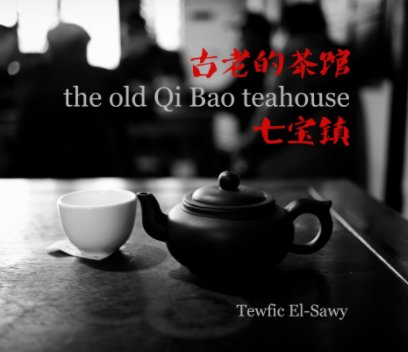
The Old Qi Bao Teahouse Photo Book | Blurb


Although I'm an inveterate proponent of on-line photographic galleries and websites, there's a certain frisson that runs down my spine when seeing my images in print and/or in book form. This is most probably in common with the majority -if not all- photographers.

So it was with this frisson that i started to view my latest photo book titles "The Old Qi Bao Teahouse". 

It's self published using Blurb and it's now available for sale in hard cover format and as a PDF.


The Old Qi Bao Teahouse
The Old Qi Bao...
By Tewfic El-Sawy
Photo book

For fuller background on the Qi Bao teahouse, I've published a gallery with explanatory text and monochromatic photographs here, as well as an audio-photo slideshow on Vimeo which includes ambient sound and a clip of a pingtan performance.


I chose an Image Wrap hard cover to give it heft and "gravitas"...and opted for the large format landscape format 13x11 inches (33x28 cm), with 56 lustre finish pages and using Blurb's ProLine Charcoal End Sheets Premium Paper. I used Blurb's proprietary software called Bookwright to produce the book's front and back covers, and its pages. Here are some of the screen grabs:


As for the processing of the photographs that were mostly made using the medium format Fuji GFX50R + 45mm 2.8mm,  I used Iridient Developer and Silver Efex Pro2. For the pages that required Chinese characters, I used Adobe Photoshop and downloaded the special Chinese font called Yengenyou.

Since Blurb only allows either JPEG or PNG, I preferred to use the latter as it's a lossless format. With all my photographs being horizontals, I reduced their size from 8256 x 6192 to 4500 x 3375 pixels and kept their resolution at 300 dpi resulting in file sizes of 10Mb or thereabouts. The color profile is sRGB IEC61966-2.1.

Monday, 13 May 2019

The Butterfly & The Teahouse | GFX50R


Hu Die (胡蝶) was one of the most popular Chinese actresses during the 1920s and 1930s. She starred in The Burning of the Red Lotus Temple, which started a craze for martial arts films, Sing-Song Girl Red Peony, China's first sound film, and what is considered her best film, Twin Sisters. She was voted China's first "Movie Queen" in 1933, and won the Best Actress Award at the 1960 Asian Film Festival for her performance in Rear Door.

Also known by her English name Butterfly Wu, she was a fervent nationalist and refused to work with the Japanese during their occupation of Shanghai. Hu Die and her husband Pan Yousheng fled to British Hong Kong at that time.

In December 1941, Hong Kong also fell to the Japanese. When the Japanese pressured her to make a war propaganda documentary film, she refused to become a collaborator, and secretly escaped to inland Chongqing, the war-time capital of the Republic of China resistance.

The photo film The Butterfly And The Teahouse encapsulates her early life until her return to Shanghai in 1945. I imagined that she would have been constantly on the move to evade the Japanese, and arranged for a photo shoot with Ms Ren Li Feng at the Qi Bao teahouse...one of the very few ancient (and virtually untouched) teahouse in the Shanghai area.

Hu Die retired in 1966, after a career spanning more than four decades. She emigrated to Vancouver, British Columbia, Canada in 1975 to join her son. She died on 23 April 1989.

The lovely soundtrack is a song by Zhou Xuan; an iconic Chinese singer and film actress. By the 1940s, she had become one of China's Seven Great Singing Stars. She was the best known of the seven, nicknamed the "Golden Voice", and had a concurrent movie career until 1954.

Saturday, 4 May 2019

Shanghai's Marriage Market | Fuji X-Pro2


Every Saturday and Sunday since 1996, Shanghai’s Marriage Market (人民公园相亲角) in the large People's Square provides parents (and grandparents) the opportunity to advertise their unmarried children by posting their vital statistics such age, height, educational qualifications and work history. 

Regardless of weather, the marriage market is held and is a popular outing for many parents and very infrequently, for unmarried youngsters as well. Posted on umbrellas and walls, hundreds of adverts with personal details important to the Chinese such as height, age, income, education, Chinese zodiac sign, and whether they own a car or an apartment... and in some cases, photographs.

I spent hours on two occasions in the Marriage Market; mingling with the locals, trying with occasional success to be invisible; or at least to become a familiar but unobtrusive sight.

Examining a poster of a glamorous woman hanging from a grille (it's in the gallery) somewhat too closely, I was almost immediately accosted by an elderly man who asked me -in sign language- if I was interested in her. Before I could indicate that I wasn't, he had called out to a nearby woman who was either the mother or was a marriage broker. Naturally, I fled rather precipitously.

I had read that the rate of success from all these adverts are very law, so I believe that the Marriage Market is primally a regular weekly outing for retired people, an opportunity to socialize with like-minded traditionalists...and yes, perhaps a chance -even a slim one- in being successful at match-making. 

In the People's Square Metro station, there's a whole corridor that is full of small stores selling wedding dresses, and other wedding paraphernalia. It must have a connection to the Marriage Market, but none of the stores were busy when I was there.


Thursday, 18 April 2019

The Old Qi Bao Tea House | Fuji GFX50R


the old teahouse by Tewfic El-Sawy on Exposure

It's been quite a while since I last posted here on the blog. This was partly due to my being involved in other activities, and planning for my 2019 travels; particularly the one on which I traveled to Shanghai and its environs.

I was able to work on a number of photographic projects in this magnificent metropolis, which will be posted here.

I will start with The Old Qibao Tea House; a gallery of about a dozen monochromatic photographs made over 4 days in an ancient traditional Chinese teahouse situated in a water town not far from Shanghai's center.

Not only does this gallery document the old style tea house and its regular customers, but also touches on pingtan or pinghua; a ancient storytelling tradition which may survive due to the Chinese government's efforts.

The old and traditional teahouse is almost invisible on the main street that's lined with shops selling local culinary specialties like pig’s trotters, boiled lamb, cakes made of polished glutinous rice, dried bean curd wrapped in lotus leaves, roasted sweet potatoes, rice wine and stinky tofu.

The teahouse features a wooden board at its entrance announcing a traditional pinghua storytelling performance, and the storyteller's name. This genre originated during the Song Dynasty (AD 960-1279). The stories are generally traditional romances, and the storytellers impersonate characters in the narration.

Stepping into the teahouse threw me back at least 50 years. Elderly men gossiping, drinking endless cups of tea, at wobbly square tables...a sort of social club for retirees. Mostly male since I only saw 3 women during my hours spent there.

More information on the tea house and the storytelling performances can be seen in the gallery.

Saturday, 9 February 2019

POV: The End of Shanghai's Lòngtáng Neighborhoods

Photo © Tewfic El-Sawy | All Rights Reserved
On the two recent occasions I was in Shanghai, I was thrilled by the abundance of candid street photography opportunities that presented themselves in its old neighborhoods. The narrow lanes crisscrossing these neighborhoods are called lòngtáng (弄堂) or alternatively, lilong (里弄), where whole communities live and sometimes work. The Shanghai lòngtáng can either refer to the lanes that its houses face onto, or to a group of houses connected by them. 

A large variety of housing styles can be found in these old neighborhoods. The best known and most characteristic is the shikumen (石库门), two- or three story terrace houses with a wall and large gate in front of each dwelling.

Interestingly, from the 1850s to the late 1940s, neighborhoods with shikumen structures were often the center of Shanghai's red light district. Gambling and opium dens commonly appeared in these neighborhoods, along with fortune tellers and other underground activities.

Photo © Tewfic El-Sawy | All Rights Reserved
I was eagerly planning to revisit some of the neighborhoods with lòngtáng on my forthcoming trip to Shanghai and add to my inventory of candid photography, but was disappointed to read that large areas of Laoximen; one of the most well known of these neighborhoods, are being demolished by the city's government in the name of modernizing the area and raising living standards.

According to Sixth Tone, Laoximen land clearance and resettlement is scheduled for completion by the end of this year with major works to start after this Chinese New Year. This extremely informative blog has a number of well researched articles on the progressive demise of Shanghai's old neighborhoods, and it's well worth the time for those interested to read them.

Photo © Tewfic El-Sawy | All Rights Reserved
In March 2018, I traveled to Shanghai to give a lecture and a street workshop at Imaging Group, and recall doing some location scouting in Laoximen with Tamia Tang (my assistant). We met an elderly resident who had lived in her small rooms virtually all her life, and had been told that she would have to vacate them soon. She claimed satisfaction that the city would be offering residents alternative housing or monetary compensation as the weather in Shanghai was too cold for her. 

From my reading of the Sixth Tone article, I gathered that the reaction of  Laoximen's residents to being given alternative housing elsewhere and/or monetary compensation is mixed. Some are resigned to moving whilst others claim that they will not move, and will hold out to the end. It's not clear what their prospects are.

I intend to find out next month when I'm in Shanghai, as Laoximen and other similar neighborhoods are on my list. 

In the meantime, here's a gallery of monochromatic photographs made in various lòngtáng neighborhoods.


shanghai by Tewfic El-Sawy on Exposure

NAKBA : Day Of Rememberance

  Nakba, meaning "catastrophe" in Arabic, refers to the mass displacement and dispossession of Palestinians during the 1948 Arab-I...