Showing posts with label X-T1. Show all posts

Saturday, 29 September 2018

Beyond The Frame | Guo Gui Lian | The Diva

(Guo Gui Lian as Xu Wen Jen)
Photo © Tewfic El-Sawy | All Rights Reserved 
I spent around a week in Penang during the latter part of August while the Chinese Yu Lan (Hungry Ghosts) Festival was being celebrated in various sites on the island. My purpose was to photograph the Chinese opera shows -and their backstages- that are an integral feature of the festival, in order to glean material for my work-in-progress photo book "Chinese Opera of the Diaspora".

(My black & white photo gallery The Unseen takes you behind the stage's curtain of this talented troupe).

One of the two main sites where Yu Lan rituals where to be held was Lim Jetty in an area called Pengkalan Weld. It's the site for the famous Sun Moon Temple dedicated to the Lim Tai Cor deity, the Lim clan patron deity. The Chinese opera (in this case, Hokkien) would be performing there on a makeshift stage of wood and thick bamboo.

The troupe performing on that stage was the “Southern Fujian Opera”, whose 16 members are mostly from this Chinese southeastern province. As I speak no Chinese, I initially communicated with Abao, one of the two male actors, using a translating app...and was able to obtain a few introductory nuggets of information, however it was with Guo Gui Lin, a lovely actress with whom I connected on stage and subsequently on WeChat on my return to New York City, that I was able to get additional information on the troupe and herself.

(Guo Gui Lian as one of the military generals)
Photo © Tewfic El-Sawy | All Rights Reserved 
Guo Gui Lian is a 30 years old single mother with a son. She hails from the port city of Zhangzhou (漳州) in Fujian. She started her career at 18 along with her sister. Her parents are farmers, and she has four siblings back home.

Through ensuing WeChat conversations, I gathered interesting -albeit sometimes conflicting- details about her troupe's involvement in the Yu Lan Festival. She arrived in Penang with the “Southern Fujian Opera” troupe on July 20 and will return to China in December. They traveled by ship from Fujian to Brunei for two weeks' shows; the sea trip took a day. It was then a flight to Penang to perform during the Hungry Ghosts festival month, and in other venues in Malaysia till year end.

Guo Gui Lian has no favorite roles. Her versatility allows her to take parts of heroic warriors, evil people, elderly and wise scholars, young boys and more. I noticed that no actor has a set role...but there are a handful who seem to take the leading roles, while others take supporting ones. Lian is one of three who took martial roles, which include some spear-sword sparring.


(Guo Gui Lian as Zhao Qing) 
Photo © Tewfic El-Sawy | All Rights Reserved 
The troupe's costumes, headgear and various accoutrements are stored in Penang; presumably by the temple authorities, until it returns the following year. The amount of these items as seen backstage precludes traveling back and forth with them on flights....so I gathered they initially traveled by boat. The troupe's manager is paid by the temple(s) and provides lodging for the performers and their salaries. The actors, sound and stage hands are paid for each show...so if there's no performance, my understanding is that they do not get paid, although I may be mistaken.

Brought by Chinese traders, Chinese opera arrived in Malaysia in the mid-16th century, and was very popular in the late 19th century. Nowadays, this ancient art form appears to be largely ignored and/or unknown by the younger generations, although efforts are made to repopularize it in Malaysia, Singapore and Hong Kong...especially during the Chinese festivals.

(Guo Gui Lian as Xu Wen Jen)
Photo © Tewfic El-Sawy | All Rights Reserved 
In Penang, Lian and her Southern Fujian Opera troupe performed its shows in Hokkien; the Chinese dialect of the south-eastern part of Fujian Province and Taiwan, and spoken widely by the Chinese diaspora in Malaysia, Singapore, Indonesia, the Philippines and other parts of Southeast Asia.

Hokkien opera is one of the most influential art forms in Malaysia and Singapore. This regional genre originated from Taiwan and flourished in Fujian. Of the more than 300 types of Chinese opera, only about eight varieties made it to Southeast Asia, the most popular ones being Chiu Chow (or Teo Chow), Cantonese, Peking and Hokkien.

The Southern Fujian Opera Troupe
Photo © Tewfic El-Sawy | All Rights Reserved


Thursday, 1 March 2018

Beyond The Frame | The Ca Trù Singer | Fuji X-T1

Photo © Tewfic El-Sawy | All Rights Reserved
Ca Trù (pronounced “ka tchoo”) is a complex form of sung poetry found in the north of Viet Nam using lyrics written in traditional Vietnamese poetic forms. It flourished in the 15th century when it was popular with the royal palace, and was a favorite activity of aristocrats and scholars. It was later performed in communal houses, inns and private homes. In 2009 Ca trù singing was inscribed on UNESCO’s Intangible Cultural Heritage “Urgent Safeguarding List.”

Its performances involve at least three people: a female singer (đào nương) who both sings and plays the clappers (known as the phách), an instrumentalist (kép) who plays the đàn đáy (three-stringed lute), and a “praise drummer“ known as quan viên who beats the trống chầu.


Historically, when spectators (usually male) entered a Ca Trù performance, they purchased bamboo tally cards. In Chinese, Trù means card, while Ca means song in Vietnamese, and thus Ca Trù means tally card songs. The tallies were given to the singers in appreciation for their performance. After the performance, each singer received payment in proportion to the number of cards received.

This ancient art was frowned upon during the Ho Chi Minh era and beyond, but was reinstated as a national treasure since then. In fact, as a result of the UNESCO inscription, some Hanoi venues have booked Ca Trù performances (thought mostly for tourists) in the city’s historic quarter.


Photo © Tewfic El-Sawy | All Rights Reserved
The venue for the three performances I attended were held at an ancient venue on 28 Hang Buom Street, whose atmospheric ambiance was just perfect for this art form. It was a sort of reenactment of what would be experienced in the 15th century, with the musicians and singers wearing silk salmon-pink ao dais and headbands. The performances usually last for 45 minutes.

I chose to use my brace of Fuji X-T1 cameras; one fitted with a 18mm and the other with the absolutely delightful 56mm. Since the venue was so dark, the lenses were wide open.

The singer-musician seen in my photographs is Ms. Đặng Thị Hường who plays the traditional Vietnamese three-stringed lute, amongst other instruments. She (wearing the dress and headband typical to the royal Vietnamese court) is also featured in my photo essay The Ca Tru Musician; the result of a photo shoot at Hanoi's Ngoc Son Temple.

The technical details for the top photograph are: Fuji XT-1+ 56mm. 1/200th sec Hand Held. f2.0. iso 1600. Spot Metering. Date: 2014-04-02 at 20:16:00 (Hanoi time). Post Processed Using Color Efex and Iridient Developer 3.

The technical details for the lower photograph are: Fuji XT-1+ 18mm. 1/350th sec Hand Held. f2.0. iso 1600. Spot Metering. Date: 2014-04-02 at 20:36:00 (Hanoi time). Post Processed Using Color Efex and Iridient Developer 3.


Here's a short clip of one of the songs I recorded during one of the performances.


Tuesday, 30 January 2018

Beyond The Frame | The Đàn Nhị Player | Fuji X-T1

Photo © Tewfic El-Sawy | All Rights Reserved
I thought I'd feature an audio file as well as an image for this post of Beyond The Frame; both which were produced during my The People of Tay Bac Photo Expedition-Workshop in September 2014; a trip which planted the seed for my two years book project Hầu Đồng: The Spirit Mediums of Vietnam (now on Amazon).

Thổ Hà village is about 40 kilometers from Hanoi, and is reachable across the narrow Cau River which we crossed on a rusty ferry. The village is known for making rice paper and banh da (rice crackers); its two main exports since 1990.

We passed a a row of old houses, and met Việt in one of the courtyards. He welcomed us into his house, offering us rice wine in small goblets. Seeing a collection of traditional instruments on his living room's walls, I asked if he played them...and he said yes. Being encouraged to play, he grabbed one of the stringed instruments and started singing a number of traditional Vietnamese songs, and entertained us for over an hour.

His favorite instrument was the đàn nhị Vietnamese, also called đàn cò; a Vietnamese bowed string instrument with two strings. The word nhị means "two" in Vietnamese. Việt was a civil servant (and possibly served in the army when younger) and had recently retired on a pension. He intended to teach his young son to play a musical instrument.

Technical Details: Fuji X-T1+ 18-135mm. 1/20 Hand Held. f4.0. iso 1600. Aperture Priority. 10:30 AM (Vietnam Time). Post Processing with Color Efex Pro.

I'm not sure why I used the Fujinon 18-135mm lens in this instance...it's my least favorite lens, I had just bought it before the trip to use for a specific photo shoot in Hoi An and it was ill-suited for this indoor low-light ambiance. I had the X-Pro1 and the 18mm f2.0 lens, so I'm puzzled as to the reason.

I recorded Việt songs on a Tascam DR-40 4-Track Mobile Digital Recorder.


Tuesday, 9 December 2014

Hội An | Tewfic El-Sawy


I'm on a roll and featuring another photo essay on Exposure; Hội An: Port of the Cham Kingdom;

This time it's of photographs made in the lovely town of Hội An during my two photo expeditions-worskhops to Vietnam in 2012 and 2014.

Departing from my usual "no frills" documentary style of travel photography, I used Color Efex Pro 4 (Nik Collection) to give the photographs a sort of glamour glow, and enhanced the mustard-yellow color of Hội An's famous walls. 

Most of the photographs were made in 2014, and made with the Fuji X-T1 camera. I generally used the Zeiss Touit 12mm (effective 18mm) lens, and the XF 18-135mm f/3.5-5.6 on specific photo shoots such as that with the traditional fisherman. For the photographs made in 2012, I used a Canon 5D Mark II.

I shared my experience using the Fuji X-T1 and the couple of lenses mentioned above on a separate post on this blog, and explain how it impressed me to the point that I didn't miss my Canon cameras during the 2+ weeks of my 2014 Vietnam adventure.

In this Hội An photo essay, I chose photographs that reflect a number of styles; street photography, fashion and model photography and pure travel.

The ancient town Hội An is a well-preserved example of a South-East Asian trading port dating from the 15th to the 19th century. Its buildings, though many have recently been converted to shops and restaurants, still have an ancient ambiance to them...despite the ever increasing influx of tourists who come to enjoy this small corner of Vietnam.

In the 18th century, Hội An was considered by Chinese and Japanese merchants to be the best destination for trading in all of Southeast Asia, but its importance dropped significantly with the development of neighboring Đà Nẵng as a main trade center.

Sunday, 5 October 2014

Verdict | The People of Tây Bắc Photo Expedition

Photo © Tewfic El-Sawy-All Rights Reserved
Having had more than a week to mull over what worked and what didn't on The People of Tay Bac Photo Expedition-Workshop, I come to the conclusion that it earns a B....not a B+, not a B-...just a plain B.

However, the trip's logistics and accommodations were faultless, and all the credit goes to the travel agent I work with in Hà Nội. They were responsive and on the ball at all times.

I think the prevailing extraordinary high humidity levels we faced all through the trip played a significant role in dampening our energy levels (certainly mine were), especially in the streets of Hà Nội. That said, and set aside...here's what I thought were home runs (or third base hits).

1. Hà Nội Street Photography:


Photo © Tewfic El-Sawy-All Rights Reserved
A definite home run.

Hà Nội's streets are just ripe for the taking of photographs...whether monochrome or color. The scenes are there and are sometimes too numerous to choose from. Visual (and aural) overload besieged my senses for the first one or two days, but then it passed and I immersed myself neck deep in the flow of life.

The Hà Nội Noir assignment to the group participants was especially well received, since it introduced them to the street photography's 'on the fly' element that they were not entirely familiar with. The shooting from the hip technique was experimented with, and provided an inventory of interesting images to each participant.

2. Hội An Fishermen:
Traditional Fisherman. Photo © Tewfic El-Sawy-All Rights Reserved
Another home run.

I had pre-arranged through Eviva, my local travel agents, a dawn-time trip on a local boat to photograph the fishermen using traditional netting systems. We boated to the mouth of the Thu Bon River to photograph these large fishing nets (see top photograph and the one above). These large contraptions are lowered into the water to catch fish during the night. They are slowly raised and lowered by the fishermen using foot-powered winches.

These must have been the most photogenic 4 hours of the entire photo expedition. The weather was just perfect, with the sun rising on cue and the whole experience was phenomenal. The subsequent hour-long visit to Hội An's main fishing harbor/market was also interesting, and offered many photographic opportunities.

3. Hầu đồng Ceremony:
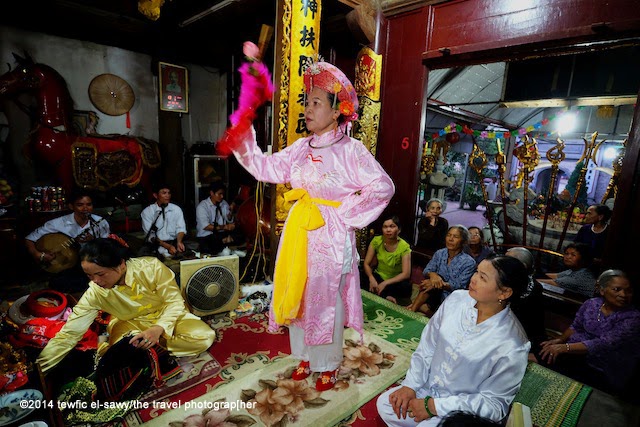

Medium in a trance. Photo © Tewfic El-Sawy-All Rights Reserved
Home run, because it's a ceremony I've never witnessed (nor heard of) before.

Hầu đồng is also known as lên đồng, and is a ritual of spirit mediumship practiced in Vietnamese indigenous religion and Đạo Mẫu, a Vietnamese mother goddess religion, in which followers become mediums for various deities.

It was by pure serendipity that we witnessed and photographed such a hầu đồng full ceremony in Bac Ha, and a rehearsal in Sa Pa. The full ceremony may last up to seven hours, and it begins with petitions to Buddha and to the deities for permission to carry out the ritual, after which the medium sits in the middle of four assistants, whose job it is to facilitate the medium's incarnation of different deities and spirits. It's a fascinating spectacle during which the medium (dressed in pink in the above photograph) chants, dances and changes in no less than 6 or 7 costumes of different colors during the ceremony.

Due to a misunderstanding, a member of our group committed a grave offense during the ceremony in Bac Ha, but a sincere apology to the temple's authorities (after which I was offered glasses of rice wine to drink to help the reconciliation along) allowed us to continue photographing. It's a testament to the generosity of the Vietnamese temple's congregation that the incident was so promptly forgiven.


4. Hội An Streets:


Photo © Tewfic El-Sawy-All Rights Reserved
Yes, Hội An is a tourist town. What can we expect from a small town recognized as a World Heritage Site by UNESCO? But setting that aside, it's a wonderfully atmospheric place with an incredible wealth of stunning backdrops for street photography, for travel photography and for fashion/model photography.

I would definitely consider staying in Hội An for a week or so. Rather than stay in the lovely and posh (but sort of generic) Hoi An Hotel, I'd stay at the Vinh Hung Hotel, an upscale but tiny heritage hotel located in the heart of town. And have Cao Lau, the local signature noodle dish  at Miss Ly every day!

It'd be wonderful to take my time...and indulge in slow street photography. In other words, pick a spot (preferably with a cup of coffee or a La Rue beer), wait and cherry-pick whatever happens in the street. As I wrote in a different post, I'd also enjoy fusing travel photography to ethnic/modern fashion photography. The style can be posed...with static portraits, or can be pseudo environmental-street portraits.
Photo © Tewfic El-Sawy-All Rights Reserved
There's no limit to the willingness of eye-catching persons, whether locals or tourists (such as the lovely Vi in the above photograph) to pose for photographers. Hội An is a magnet for newly-weds (or about to be married) who come here with their make-up artists and photographers.

Photo © Tewfic El-Sawy-All Rights Reserved
The pretty and lively bride in pink loved my suggestion that she pose under the bird cages...I told her that it'd be an appropriate setting since they were lovebirds. She left her photographer, and ran to the spot I indicated. Nothing is set up in this photograph...the brooms, the bird cages, the bicycle...all was left as is. That's Hội An.

Photo © Tewfic El-Sawy-All Rights Reserved
A bride-to-be is being dolled-up by her make-up artist, just around from the famous Japanese Bridge. It's these quotidian scenes that attract me visually to places like these. Yes, here the bride saw the photographer...but I'd wait for as long as it took to become just part of the background, and for a scene (a story) to develop.

Have I said that Hội An was a home run? If I haven't yet, then yes...it is.

5. The Tây Bắc Region:

Flower Hmong in Bac Ha. Photo © Tewfic El-Sawy-All Rights Reserved
I need to be quite emphatic about this: I resent blue tarpaulins, motorbike helmets, motorbikes and baseball caps photo-bombing my photographs.  

So no home run for the northern region of Tây Bắc, which for us mostly meant the markets of Bac Ha, Can Cau, and Coc Ly. We had to pass on Xin Cheng market due to Typhoon Kalmaegi. The exception was Sa Pa, which is a nice little town with some opportunities for street photography and ethnic photography of the H'mong.

Bac Ha market is the largest of the region, and perhaps because I had been before, it didn't have the visual umph it had when I was there in 2012. One thing for sure has changed...the area where the Flower Hmong, Dzao and others ate their breakfasts and lunches was moved by Bac Ha municipality (or whatever it's called) from the center of the market to the right of its entrance. It's now more orderly, but it removed the ad hoc feel that the market had before the move.

And because of the threatening rain, blue tarpaulins were stretched all over the stalls...giving out a rather nasty light to faces and clothes. 

That said, Bac Ha is still the granddaddy market of the region. As we had spent the night at the nearby Sao Mai hotel, we had the market almost to ourselves until 10:00 am. When the tourists arrived with their GoPro and heavy cameras, we left for breakfast.

Flower Hmong Matriarch in Can Cau. © Tewfic El-Sawy-All Rights Reserved
Can Cau Market is held on Saturdays, and is predominantly frequented by the Flower H’mong. While not far from Bac Ha, it took us about 3 hours to drive from Sa Pa. Much smaller than the Bac Ha market, it doesn't have its 'charisma'. It'd be easy to blame the humidity, but it was quite high...and it drained us of energy quite rapidly. The locals seemed to take the humidity in stride, carrying umbrellas and sometimes fans.

Flower Hmong family in Can Cau-© Tewfic El-Sawy-All Rights Reserved
Coc Ly market is held weekly on Tuesdays, and is also crowded with Flower H’mong. Only 35 kilometers from Bac Ha, the roads are quite nasty and bumpy...and were probably made worse during the rainy season. It's perched on a hillock, and it struck me as one of the least interesting. I was amused when a meddlesome American woman kept watching me photographing a very amenable Flower Hmong for a while, and then told me to stop because I was "harassing" her.

In short, there indisputably were some interesting photographs to make in these markets, but group tourism's tentacles have reached these markets, and they've lost some of their authenticity. I suspect many of the implements and products sold to to the locals are made in China...while the handicrafts presumably made by the local minorities seems to be shoddier than usual.

In a future iteration, a People of Tây Bắc Photo Expedition will continue to be based in Sa Pa but will venture to markets and villages further afield...as far as possible from tour buses, it that's possible.

6. Sa Pa:


Hmong in Sa Pa market. Photo © Tewfic El-Sawy-All Rights Reserved
I like Sa Pa. The Victoria Hotel is great...although their staff can be somewhat impersonal. But that's what happens when your guests are mostly tour groups. The restaurants are welcoming, all have free wi-fi and the food is quite good. Not as good as Hoi An...but good.

Yes, I like Sa Pa...it wasn't misty nor cool as it was in 2012, and the main square is now empty of the Hmong vendors that had taken it over in the late afternoons. They've been chased away, and given a dreary space above the market to sell their goods. Presumably to have them pay a permit fee or something like that.

Along with the group, I enjoyed doing some monochrome work in the tiny market; exploiting the chiaroscuro of its alleys, and the black dress of the Hmong as best I could. It was in Sa Pa that I also stumbled on a Hầu đồng rehearsal ceremony, which in a way prepared us for the real thing in Bac Ha.


Hoi An Lanterns. © Tewfic El-Sawy-All Rights Reserved
So what would I do differently?

If I was omnipotent, I'd change the weather. It affected the attendance of the Tet Trung Thu street festival; it prevented us from attending the least touristy market in the northern region and it exhausted us.

But within my direct control, I'd reduce the number of days in Hà Nội and increase the stay in Hội An. I'd still stay in Sa Pa, spend a day in Bac Ha, but travel much further in search of traditional small villages that are not on the tourist trail.

Red Dzao in Ta Phin. Photo © Tewfic El-Sawy-All Tights Reserved
Now, the finale for the those who like statistics. My estimated usage of my cameras was as follows:
Fuji X-T1 + Zeiss Touit 12mm f2.8: 75%
Fuji X-Pro1 + Fujinon 18mm f2.8 : 10%
Leica M9 + Voigtlander 40mm f1.4: 15%

(I used the Fuji Zoom XF18-135mm f3.5-5.6 for the fishermen photo shoot, and another time in Hà Nội 
around Hoàn Kiếm lake.)

Did I miss my Canon 5D Mark II and my panoply of primes and zooms? 

No. Not once.

NAKBA : Day Of Rememberance

  Nakba, meaning "catastrophe" in Arabic, refers to the mass displacement and dispossession of Palestinians during the 1948 Arab-I...